
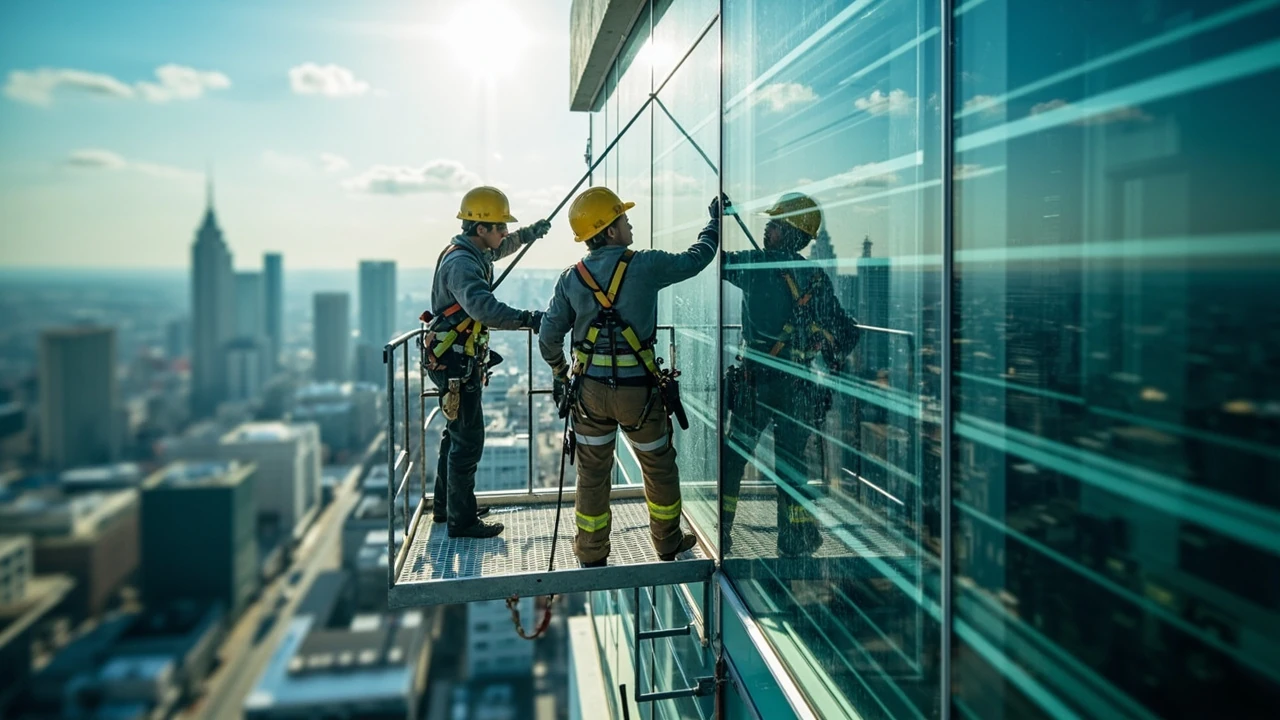
Commercial window washing: what property managers need to know
A property manager for a four-story medical office building calls three window cleaning companies for quotes and gets answers that range from $1,400 to $4,800 for the same square footage. The spread is not a scam or a mistake. It reflects real differences in how commercial window washing is scoped, what is included, how workers access the glass, and what insurance and safety planning the job actually requires. Knowing how those pieces fit together is what turns a confusing bid into a defensible decision.
Commercial window washing is the scheduled or on-demand cleaning of exterior and interior glass on buildings that are not single-family homes, including office towers, retail storefronts, medical facilities, schools, restaurants, hotels, warehouses with glazed entries, and industrial facilities with administrative glass. The work blends routine maintenance, safety planning, specialized equipment, and coordination with tenants and the public. This guide explains how the service is delivered, what it should cost, how often it is needed, and what to check before signing a contract.
What commercial window washing actually includes
Most property managers picture a person with a squeegee and a bucket. On a small storefront, that is often exactly what shows up. On larger properties, the scope expands considerably. A clear understanding of the included services prevents disputes when the invoice arrives.
Typical scope of work
- Exterior glass cleaning, including windows, curtain walls, and storefront panels
- Interior glass cleaning, including lobby windows, conference rooms, partitions, and interior doors
- Window frames, mullions, sills, and tracks where reachable
- Screen removal, cleaning, and reinstallation when screens are present
- Spot treatment of hard water stains, mineral deposits, paint overspray, tape residue, and construction debris
- Skylight and atrium glass where safely accessible
- Post-construction window cleaning after renovations or new tenant buildouts
- Optional add-ons such as pressure washing of entryways, awning cleaning, or solar panel rinsing
Services that are usually separate
Window washing companies often draw a line between glass and everything else. Items commonly billed separately include high-dust removal from beams and ceilings, light fixture cleaning, gutter clearing, bird deterrent installation, and permanent stain removal that requires restoration rather than cleaning. Reading the scope line by line is the easiest way to avoid assumptions.
Access methods: how the glass actually gets cleaned
The biggest variable in any bid is access. The taller or more awkward the building, the more the cost moves away from labor and toward equipment, rigging, and safety overhead. The four main access methods are described below.
| Method | Typical use | Equipment involved | Cost impact |
|---|---|---|---|
| Ground-based, water-fed pole | Low-rise buildings up to about 4 stories | Purified water system, telescoping carbon fiber or aluminum pole, brush head | Lowest cost per square foot; minimal setup time |
| Ground-based, traditional squeegee | Storefronts and ground-floor glass | Squeegee, applicator, bucket, mild detergent | Low cost; limited by ladder reach |
| Aerial lift or scissor lift | Mid-rise buildings, atrium interiors, loading bays | Boom lift, scissor lift, sometimes a spotter | Moderate cost; requires clear ground space and permits |
| Rope access (industrial climbing) | High-rise facades, irregular shapes, areas lifts cannot reach | Two-rope system, harness, descender, anchorage plan, often a boatswain’s chair | Highest cost per drop; lowest setup footprint |
For low-rise offices, retail strips, medical buildings, and most properties under four stories, a water-fed pole system with purified water is now the dominant approach because it eliminates the need to climb ladders, leaves no detergent residue, and reaches glass that older methods could not. For taller or more complex facades, rope access crews and aerial lifts become the deciding factor in both price and scheduling.
How often commercial windows should be cleaned
There is no single correct frequency. The right answer depends on the building’s location, the type of business, weather exposure, and the standard the owner wants to maintain. The general framework below is a starting point rather than a rule.
| Property type | Recommended exterior frequency | Notes |
|---|---|---|
| Urban high-rise office | Monthly to quarterly | Dust, pollution, and rain spotting accumulate quickly on tall facades |
| Suburban low-rise office or medical | Quarterly to semi-annually | Pollen in spring and road film in winter drive the schedule |
| Retail storefront | Monthly to quarterly | Smudges and fingerprints on door glass are visible to every customer |
| Restaurant | Monthly exterior, weekly interior | Grease film on interior glass is a separate problem from exterior dirt |
| Hotel | Monthly exterior, interior as needed | Lobby and elevator glass often need more frequent attention |
| Industrial or warehouse office | Semi-annually to annually | Often limited to entry glass and a glazed front office |
| Post-construction | One-time deep clean, then normal cycle | Construction dust, paint, and labels require restoration-level work first |
For most suburban commercial properties, a quarterly exterior schedule with interior glass on an as-needed basis keeps the building presentable without overspending. A reputable commercial window washing service in Washington typically suggests a similar default and adjusts based on site conditions.
Safety requirements and why they change the price
Commercial window washing is one of the more dangerous routine maintenance tasks in property management. Falls from height are the primary hazard, followed by electrical contact with overhead lines, dropped objects, and chemical exposure. The reason a four-story job sometimes costs more than expected is rarely the soap. It is the safety program behind it.
What a qualified contractor should have in place
- General liability insurance, often $1 million to $5 million, with the property owner named as additional insured when requested
- Workers’ compensation coverage for every crew member
- Documented fall protection plan that matches OSHA 1910.140 and ANSI/IWCA I-14.1
- Trained and certified rope-access technicians for any descent work
- Pre-job hazard assessment, including overhead power lines, anchor points, and pedestrian control
- Daily equipment inspection logs and a rescue plan for suspended workers
Tenant and pedestrian safety
On a busy site, the safety plan is only half about the workers on the rope. The other half is about the people walking below. A professional crew cordons off the work area with cones, caution tape, or barriers, posts a ground spotter, and schedules overhead work outside peak foot traffic when possible. Property managers should expect to be asked to approve a pedestrian plan before work begins, and should treat a contractor who waves off the question as a warning sign.
How commercial window washing is priced
Pricing varies widely by region, building height, and scope. The figures below are typical ranges for the United States as of recent industry surveys; they are intended to help interpret a bid, not to replace one.
| Service | Typical cost range | Unit | Main driver of price |
|---|---|---|---|
| Ground-floor storefront, traditional method | $2 to $5 | Per pane | Number of panes and accessibility |
| Low-rise exterior, water-fed pole | $0.10 to $0.30 | Per square foot of glass | Height, soil level, and water access |
| Mid-rise exterior, lift or swing stage | $0.30 to $0.75 | Per square foot of glass | Equipment mobilization and rigging |
| High-rise exterior, rope access | $0.50 to $1.50 or more | Per square foot of glass | Anchor certification, crew size, complexity |
| Interior glass, general office | $2 to $6 | Per pane | Number of panes, partitions, and conference rooms |
| Post-construction clean | $0.75 to $2.00 | Per square foot of glass | Label, paint, and adhesive removal |
Most vendors price a recurring contract on a per-visit basis with a discount compared to a one-time clean. Bundling interior and exterior into the same visit usually reduces the per-visit cost because the crew is already mobilized.
In-house crew versus outsourced contractor
Some larger property portfolios keep a small in-house maintenance team and add window washing to their duties. For a single low-rise building, that approach rarely saves money. For a portfolio of ten or more similar properties, the math can flip.
When outsourcing usually wins
- Any work above two stories, where fall protection training becomes a real cost
- Properties with less than quarterly service, where mobilization dominates the invoice
- Buildings with mixed glass types, such as skylights, atriums, and storefronts, which require different tools
- Sites where liability exposure is a concern, since insurance shifts to the contractor
When an in-house team can be justified
- A large portfolio of similar low-rise properties clustered in one region
- Daily or weekly interior glass needs, such as a hotel, where a small dedicated team is more efficient than recurring vendor visits
- Owner-operated buildings where the team already handles other facade maintenance
The decision rarely comes down to labor cost. It comes down to insurance, training time, equipment storage, and how predictable the workload actually is from month to month.
What to check before hiring a commercial window washing company
A short, focused vetting process filters out most of the risk. The checklist below is the practical version of what experienced property managers ask before signing.
- Confirm general liability and workers’ compensation coverage, and ask for a certificate of insurance naming your company.
- Ask whether the crew is W-2 employed or 1099 subcontracted. W-2 employment usually means better training and accountability.
- Request a written safety plan that covers fall protection, anchor inspection, and pedestrian control.
- Ask for references from properties similar in height and use to yours, and actually call them.
- Clarify the scope in writing, including interior versus exterior, screens, tracks, frames, and post-construction cleanup.
- Confirm scheduling flexibility, since retail and medical tenants often need off-hours or early-morning service.
- Ask about recurring contract discounts, since a quarterly schedule is usually cheaper per visit than four one-time cleans.
- Check how the company handles damage, since scratched glass and water intrusion are the two most common claims.
Common problems and how to avoid them
Most disputes in commercial window washing fall into a small number of predictable categories. Understanding them in advance makes the contract language easier to write.
Streaks and spotting
Streaks usually mean the wrong tool for the glass, hard water in the rinse, or work done in direct sun. Purified water systems and work scheduled for shaded hours reduce this complaint sharply. If streaks appear anyway, a free re-clean within a stated window should be part of the contract.
Hard water stains and mineral deposits
White, cloudy marks on exterior glass are often mineral deposits from sprinklers or roof runoff rather than dirt. Routine cleaning will not remove them. They require a restoration process with mild acids or specialized polishing pads, which is a separate scope and a separate price. Set expectations early so the restoration is not treated as a failed clean.
Damage to seals, frames, or tint
High-pressure water, aggressive scraping, and the wrong chemical can damage window seals, gaskets, and films. A pre-job walkthrough that photographs vulnerable areas protects both sides. Any existing damage should be documented in writing before the crew starts.
Liability for dropped tools or water intrusion
Dropped tools are a real risk in rope-access work. A reputable contractor carries tools with lanyards and limits what is carried aloft. Water intrusion into tenant space is almost always a result of worn seals rather than the cleaning itself, which is another reason a pre-job walkthrough matters.
Environmental and regulatory considerations
Exterior cleaning of commercial buildings intersects with a few rules that property managers should at least be aware of, even if the contractor handles the day-to-day compliance.
Water use and runoff
Water-fed pole systems with purified water can reduce total water use compared to traditional methods because the rinse water is already optimized for spot-free results. In jurisdictions with stormwater rules, contractors are expected to control detergent runoff so it does not enter storm drains. Pure-water systems sidestep much of this concern.
Tax classification of cleaning services
In some U.S. states, exterior cleaning services such as window washing are treated as taxable services. The contractor is typically responsible for collecting and remitting the tax, but property managers should confirm how taxes appear on the invoice and whether their tax-exempt status, where applicable, is being applied.
Anchor and fall-protection certification
For rope-access work, the anchors on the roof are part of the building’s life-safety system. They need periodic inspection by a qualified person, and the report should be available to the contractor before work begins. If anchors have never been certified, the contractor may need to install temporary anchors, which adds cost and requires roof penetrations.
Working with tenants during a window washing project
Tenant relations are a soft cost that is easy to underestimate. A multi-tenant office building with fifty businesses needs more communication than a single-tenant warehouse, even when the physical work is smaller.
- Give tenants a written notice at least one to two weeks before the work, with the dates, the windows that will be affected, and a contact for questions.
- Schedule interior glass work floor by floor or suite by suite to limit disruption.
- Ask tenants to keep blinds open on scheduled days so the crew can reach the interior surface without forcing the mechanism.
- Protect sensitive items near the windows, since crews will be moving ladders and poles close to desks and displays.
- Confirm whether any tenant has a security or operational concern, such as a server room, that requires extra coordination.
How to compare two bids that look very different
When one bid is far lower than another, the gap is almost always explained by a difference in scope, access method, insurance, or frequency. A structured comparison removes the guesswork.
| Question to ask | Why it matters |
|---|---|
| Is the price per visit or per year? | A low per-visit price with a longer frequency can cost more annually than a higher per-visit price with more frequent service. |
| What is the access method for each elevation? | Pole, lift, and rope access are priced in different tiers and have different safety requirements. |
| Are interior and exterior both included? | Interior glass is often excluded from low exterior bids and added later as a change order. |
| What is the insurance limit and who is named? | A lower premium often means lower coverage, which matters if a worker is hurt on site. |
| What is the re-clean policy? | A clear re-clean window within 24 to 72 hours is standard for a professional contractor. |
| Are screens, tracks, and frames included? | These line items add up and are easy to miss in a verbal scope. |
Seasonal and weather planning
Commercial window washing is weather-sensitive in ways that are easy to forget when scheduling a year in advance.
- Exterior work is paused when temperatures drop below about 35°F, since water can freeze on the glass and create hazards for workers and pedestrians.
- Wind above roughly 25 to 30 mph typically suspends rope-access and lift work, even on otherwise clear days.
- Heavy rain does not usually require a reschedule on its own, but it can affect water-fed pole work if the purified water supply is limited.
- Spring pollen and fall leaf debris drive a noticeable increase in service requests, which can push lead times out by a week or more in some regions.
A practical approach is to book the recurring schedule at least one season ahead, then confirm the visit two to three days out based on the short-term forecast.
Reducing the cost of commercial window washing over time
There is a limit to how cheaply any vendor can clean glass safely, but there are real ways to keep the long-term cost down without cutting corners.
- Bundle properties. A vendor servicing multiple buildings for the same owner usually offers a portfolio discount.
- Lock in a multi-year recurring contract. Annual price increases are smaller when the term is committed.
- Schedule off-season. Booking winter or shoulder-season work sometimes earns a small discount because demand is lower.
- Pre-walk the building. Documenting existing damage and problem areas reduces change orders and disputes.
- Maintain a simple log of visits. The log makes it easy to confirm the work was done and to flag issues before the next visit.
Frequently asked questions
What is the difference between window cleaning and commercial window washing?
The terms are used interchangeably in most of the industry. Commercial window washing typically refers to the exterior cleaning of glass on non-residential buildings, often involving purified water, lifts, or rope access, while window cleaning is the broader term covering both residential and commercial work. Pricing, equipment, and safety planning differ more between residential and commercial than between the two phrases.
How long does a typical commercial window washing job take?
A small storefront can be finished in an hour or two. A low-rise office building of 20,000 to 50,000 square feet of glass usually takes a single crew one to two days with water-fed poles. Mid-rise and high-rise projects are scheduled by elevation and weather, and can take several days to a few weeks depending on square footage and access.
Do cleaners need to come inside the building?
For interior glass, yes. Most contractors schedule interior work during business hours, often early morning, and coordinate with tenants floor by floor. For exterior-only service, the crew usually does not need interior access except to use a water supply or, in some cases, to access interior surfaces of atrium glass.
Is commercial window washing dangerous?
It is one of the more hazardous routine maintenance tasks because most of the work is performed at height. A qualified contractor reduces the risk with proper fall protection, anchor certification, crew training, and pedestrian control. Property managers should treat any contractor who cannot describe their safety plan in writing as a liability, not a bargain.
Can commercial window washing remove hard water stains?
Standard cleaning will not. Hard water stains and mineral deposits require a restoration process using mild acids, specialized pads, or polishing compounds, which is a separate scope and a separate price. Setting this expectation up front avoids the impression that a routine clean has failed.
How do I know whether my building needs rope access or a lift?
For buildings up to about four stories, a water-fed pole from the ground is usually enough. Above that, the decision depends on the facade shape, the location of overhead obstructions, and whether anchors are already certified. The contractor should recommend an access method after a site visit, not before.
What insurance should a commercial window washing company carry?
At minimum, general liability, workers’ compensation, and commercial auto coverage, with limits appropriate to the building’s size and height. High-rise projects often require higher liability limits, sometimes $5 million or more, and may require additional insured status for the property owner. Ask for a certificate of insurance and verify it directly with the carrier.
Should I sign a long-term contract or pay per visit?
For a property with a predictable cleaning need, a recurring contract is usually cheaper per visit and guarantees a slot in the schedule. For a building whose needs are uncertain, a per-visit arrangement gives flexibility without locking in service. The middle path is a one-year contract with a 30-day cancellation clause.
Are there eco-friendly options for commercial window washing?
Pure-water systems are the most common eco-friendly approach because they eliminate detergent and reduce total water use. Some contractors also offer biodegradable cleaning solutions for interior glass. Property managers with sustainability goals should ask specifically about the system being used rather than relying on a generic green claim.
What should I do if a window is scratched during cleaning?
Document the damage immediately with photographs, notify the contractor in writing, and ask for their damage policy in advance so the response is clear. Most established companies carry insurance that covers accidental glass damage, and a pre-job walkthrough with dated photos makes any claim much easier to resolve.
Leave a Reply