
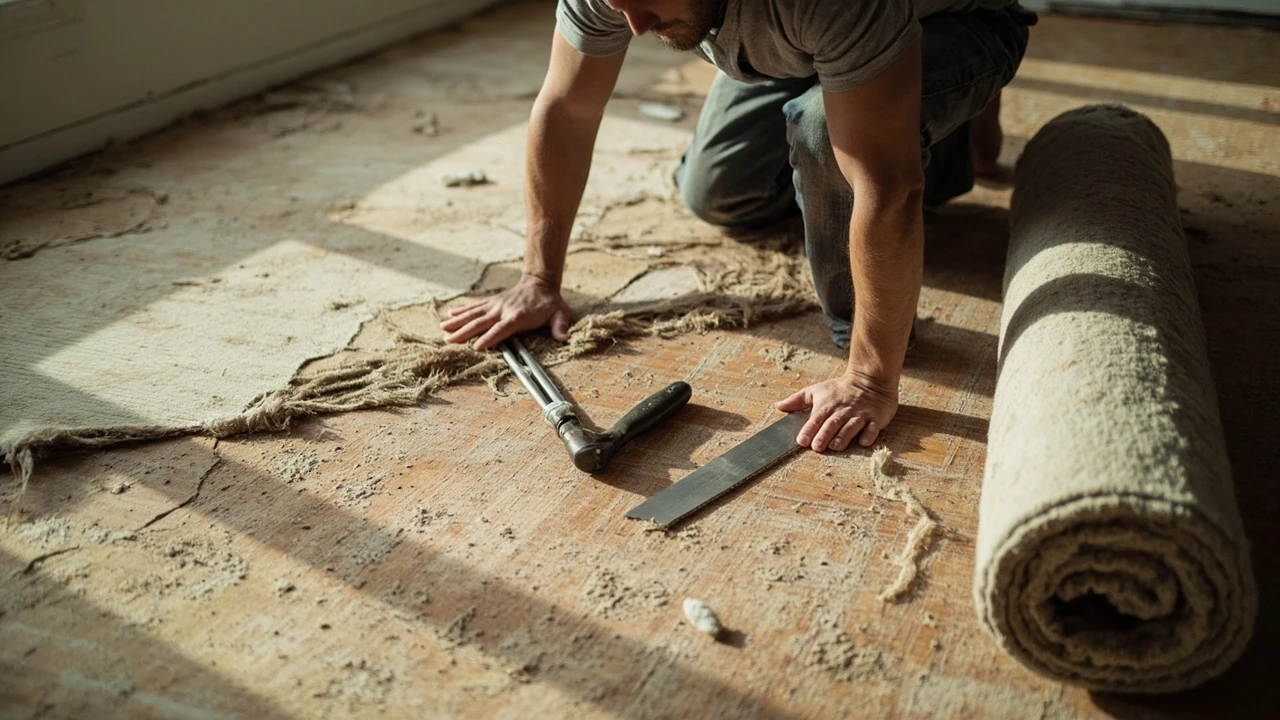
Carpet removal cost: what homeowners actually pay in 2026
A contractor in Texas recently quoted a homeowner $1,150 to pull up 800 square feet of glued-down carpet, haul the debris away, and leave the concrete subfloor broom-clean. The homeowner had expected the job to take half a day and cost under $400. The gap between expectation and reality is the single most common surprise in any flooring replacement, and it usually comes down to a misunderstanding of what carpet removal cost really includes.
Carpet removal cost is not a single line item. It combines labor to detach and roll the carpet, padding disposal, adhesive or tack strip work, hauling fees, and, in some homes, subfloor preparation. The price you see advertised for “carpet removal” almost always refers to the labor for a straightforward room of wall-to-wall carpet on tack strips, and it almost never includes disposal, furniture moving, stairs, or glued flooring. This article breaks down the real components of carpet removal cost, the price ranges a homeowner is likely to encounter in 2026, and the decisions that move a quote up or down by hundreds of dollars.
What is actually included in a carpet removal quote
Most professional carpet removal jobs cover the same set of tasks, but the way a contractor defines those tasks can change the price by 30 to 60 percent. Before comparing two estimates, make sure both are scoped against the same work.
The baseline scope of a carpet removal service typically includes:
- Moving light furniture and emptying the room where work will be done
- Detaching carpet from tack strips along the perimeter of each room
- Rolling or folding the carpet and removing the underlying padding
- Pulling tack strips if the new flooring will not reuse them
- Sweeping or vacuuming the exposed subfloor
- Loading debris into a truck or trailer for disposal
Several add-on items are frequently excluded from a base quote, even though they affect the final bill. Homeowners are often surprised by charges for moving heavy furniture like sectional sofas or pool tables, hauling away bulky items such as area rugs that were layered over wall-to-wall carpet, or breaking down carpet that has been glued directly to concrete or wood. Stairways are another frequent extra because each step must be cut and removed separately, and many contractors price stairs by the step rather than by the square foot.
Average carpet removal cost in 2026
National averages for carpet removal cost shift every year as labor, fuel, and landfill fees change. The figures below reflect typical 2026 pricing across the United States for residential projects, based on widely reported industry ranges. Your local market, especially in coastal metropolitan areas, can run 20 to 40 percent higher than the national midpoint.
Cost by square footage
Most contractors price carpet removal by the square foot for the main living areas, then add separate line items for stairs, closets, and disposal. The table below shows the ranges a homeowner is most likely to see in 2026.
| Project size | Square footage | Typical labor range | Likely total with disposal |
|---|---|---|---|
| Single small room | 100–200 sq ft | $100–$250 | $180–$400 |
| Bedroom (typical) | 200–300 sq ft | $200–$400 | $300–$600 |
| Whole home, single story | 800–1,200 sq ft | $500–$1,000 | $700–$1,400 |
| Whole home, two story | 1,500–2,500 sq ft | $900–$1,800 | $1,200–$2,500 |
| Large custom home | 3,000+ sq ft | $1,500–$3,000+ | $2,000–$4,000+ |
The “likely total with disposal” column assumes standard roll-and-haul disposal at a local landfill or transfer station. Areas with higher tipping fees, restricted landfills, or limited contractor access can push the same square footage into the upper end of those ranges. Carpet that is glued down rather than stretched over tack strips generally adds 25 to 50 percent to the labor portion because of the extra scraping and adhesive work.
Cost by removal method
How the carpet is attached to the floor is one of the largest drivers of carpet removal cost. The table below compares the most common scenarios a contractor will encounter on a quote walk-through.
| Removal type | Typical difficulty | Price per sq ft | Notes |
|---|---|---|---|
| Wall-to-wall on tack strips | Low | $0.50–$1.00 | Standard stretch-in carpet over padding |
| Wall-to-wall with staples | Low to moderate | $0.75–$1.25 | Padding stapled to wood subfloor |
| Glued-down carpet on concrete | Moderate to high | $1.00–$2.50 | Requires scraping and adhesive solvent |
| Double-glued pad and carpet | High | $1.50–$3.00 | Common in commercial and some 1990s homes |
| Stair carpet (per step) | Moderate | $5–$15 per step | Priced separately from main rooms |
Glue-down carpet is the most common reason a quote jumps after a contractor walks the home. A 200-square-foot bedroom with glued carpet can take as long as a 600-square-foot stretch-in room, and the labor difference shows up directly in the price.
What drives carpet removal cost up or down
Two homes with the same square footage can receive quotes that differ by several hundred dollars. The difference almost always comes from a handful of variables that are visible to an experienced estimator on the first walkthrough.
Attachment method and subfloor
Stretch-in carpet on tack strips is the fastest scenario because the carpet lifts off in large sheets. Stapled padding adds a small amount of time but is rarely a major cost driver. Glued-down carpet and padding are a different story. Removal usually requires a long-handled floor scraper, a heat gun or solvent in stubborn spots, and patience. A contractor who encounters heavy adhesive residue may also recommend grinding the subfloor before new flooring goes down, which is a separate line item.
Room layout and stairs
Open floor plans are faster per square foot than homes with many small bedrooms, closets, and hallways. Each transition, doorway, and closet adds a cut and a separate piece to handle. Stairs are priced by the step because each tread and riser must be cut individually. A 14-step staircase typically adds $100 to $200 to a project, but curved or spiral stairs can be substantially more.
Furniture and access
Most contractors expect to move lightweight items like chairs, side tables, and lamps. Heavy pieces such as sectionals, pool tables, and antiques are usually handled for an extra fee or moved by the homeowner before the crew arrives. Tight stairways, narrow doorways, and long walks from the front door to the work area can also slow a job, especially in multi-story homes or urban townhouses.
Disposal and hauling
Disposal is often the most under-counted line on a do-it-yourself estimate. Many landfills have restrictions on carpet because the synthetic fibers, backing, and adhesives can be slow to break down, and some facilities refuse to accept it altogether. Contractors who include disposal in their quote usually have a relationship with a transfer station, recycler, or carpet removal and disposal service that processes the material properly. That access is part of what you are paying for, not just the truck time.
Regional labor and disposal fees
Labor is the single largest component of carpet removal cost in most homes, so regional wage rates matter. A 1,000-square-foot removal in a midwestern city may price in the $500 to $800 range, while the same project in a coastal metro can run $1,000 to $1,500. Landfill tipping fees and local regulations on construction debris also push prices higher in markets with strict disposal rules.
DIY vs. hiring a professional
Carpet removal is one of the few renovation tasks that a determined homeowner can realistically do without specialized training. The main trade-off is time, disposal logistics, and the risk of subfloor damage. The list below compares the two approaches on the points that matter most.
- Cost: DIY usually runs $50 to $200 for tools and disposal fees, while professional removal is typically $0.50 to $2.50 per square foot of labor plus hauling.
- Time: A homeowner working alone can spend 8 to 16 hours on a whole-home removal; a two-person crew can do the same job in 4 to 8 hours.
- Tool needs: DIYers need a utility knife, pry bar, heavy gloves, a floor scraper, and a way to haul debris, often a rented truck or trailer.
- Disposal: Professionals usually have a disposal route already arranged. DIYers typically need to coordinate a drop-off at a facility that accepts carpet.
- Subfloor risk: Improper scraping can gouge wood or concrete, creating extra prep work before new flooring is installed.
- Health and safety: Old carpet can harbor dust, allergens, and, in homes built before 1980, possible asbestos in the underlying adhesive. A professional is more likely to identify and test for these issues.
The break-even point between DIY and professional removal is usually around 500 square feet. Below that, the time and disposal hassle often justify paying a crew. Above that, the savings from doing it yourself start to feel real, especially if you have access to a truck and a helper.
How to get an accurate carpet removal estimate
Most carpet removal cost disputes come from vague scopes rather than bad-faith contractors. A clearer brief on both sides usually produces a more accurate quote and fewer surprises on the day of the job.
- Measure the total square footage of carpeted areas, including closets, and count the number of stairs.
- Note how the carpet is attached: stretched over tack strips, stapled padding, or glued down to concrete or wood.
- Identify any heavy furniture, wall-mounted televisions, or built-ins that the crew will need to work around or move.
- Ask whether the quote includes disposal, hauling, and any subfloor scraping or adhesive removal.
- Confirm whether the crew will pull and dispose of the tack strips, or leave them in place for the new flooring installer.
- Request a written breakdown that separates labor, disposal, and any add-on fees so the bids can be compared line by line.
Two contractors quoting the same job can produce numbers that look close but mean very different things. A bid of $700 with disposal included is not the same as a bid of $700 for labor plus a $300 hauling add-on, even though the totals may end up similar. The line items, not the headline number, are what should drive the decision.
Questions to ask before hiring a carpet removal crew
The cheapest quote is not always the best one, and the most expensive quote is not always the most thorough. A short list of targeted questions helps a homeowner separate a careful contractor from one who is guessing.
- Is the quote a firm number or an estimate that can change once work begins?
- What is included in the labor, and what counts as an extra charge?
- How is the carpet and padding disposed of, and is recycling an option?
- Are stairs, closets, and transitions priced per step, per room, or as part of the total square footage?
- Does the crew carry insurance for accidental damage to the subfloor or adjacent surfaces?
- What is the policy if the carpet is glued down and was not identified in the original walkthrough?
- Will the tack strips be removed, and is that part of the base price?
Contractors who answer these questions directly and in writing are usually the same contractors who show up on time and finish the job without arguments about the bill.
How carpet removal cost fits into a larger flooring project
Carpet removal is rarely the end of the work. In most homes it is the first step in a sequence that includes subfloor repair, new underlayment, and the new flooring itself. The removal cost is small compared to those later steps, which is one reason many homeowners choose to fold the removal into the new flooring contract rather than hiring a separate crew.
A few practical considerations matter at this stage:
- If new carpet is going down, the old tack strips can often be reused, which reduces both labor and the disposal stream.
- If a hard surface like luxury vinyl plank or engineered wood is replacing carpet, the subfloor condition becomes critical, and any dips or adhesive residue need to be addressed before installation.
- Some flooring manufacturers will void their warranty if the subfloor is not within a specific flatness tolerance, so a small additional investment in leveling compound can prevent a much larger claim later.
Coordinating the removal with the new flooring installer also means one crew handles the entire transition, which usually reduces the risk of miscommunication about who is responsible for a rough or damaged subfloor.
Ways to keep carpet removal cost under control
There is not much room to negotiate on a straightforward stretch-in removal, but several decisions can meaningfully reduce the final bill.
- Clear the rooms yourself before the crew arrives so labor is not spent moving furniture.
- Pull small area rugs and runners ahead of time, and stage them for pickup by a separate service if needed.
- Combine carpet removal with other demolition work, such as baseboard or tile removal, to share the trip charge.
- Ask whether the contractor can take the carpet to a recycling facility rather than a landfill, which is sometimes cheaper.
- Schedule the work during the contractor’s slower season, often late fall or winter in colder markets, when discounts are more common.
- Leave tack strips in place if the new flooring will be carpet and the strips are in good condition.
None of these steps will cut the cost in half, but together they often save 10 to 20 percent and shorten the time the crew spends on site.
Frequently asked questions
How much does carpet removal cost per square foot?
Most homeowners pay between $0.50 and $2.50 per square foot for the labor portion of carpet removal, depending on how the carpet is attached. Stretch-in carpet on tack strips is at the low end, while glued-down carpet on concrete or double-glued installations sit at the high end. Disposal typically adds another $0.10 to $0.30 per square foot on top of labor.
Does carpet removal cost include hauling the old carpet away?
Not always. Some contractors include disposal and hauling in their base price, while others quote labor only and add a separate hauling or dump fee. Always ask whether the quote covers the full chain of work from pulling up the carpet through dropping it at a disposal facility.
Is it cheaper to remove carpet myself or hire a crew?
For projects under about 500 square feet, the savings from doing it yourself are usually small once you factor in tool rental, a truck, dump fees, and the value of your time. Above 500 square feet, DIY can save several hundred dollars, especially if you have a helper and a disposal plan. The main trade-off is the physical effort and the risk of damaging the subfloor.
Why is glued-down carpet more expensive to remove?
Glued carpet is bonded directly to the subfloor with adhesive, which means it cannot be rolled up in large pieces the way stretch-in carpet can. Removal requires cutting it into smaller sections, scraping the backing, and often using a heat gun or solvent to deal with adhesive residue. That extra labor is the main reason glued-down removal runs $1.00 to $3.00 per square foot instead of $0.50 to $1.00.
Do I need to remove the tack strips when the carpet comes up?
Not necessarily. If the new flooring will be carpet, the existing tack strips can usually be reused as long as they are in good condition and securely fastened. If the new flooring is a hard surface, the tack strips almost always need to come out because they sit proud of the subfloor. Removing tack strips is a fast add-on but is sometimes priced separately from the main removal.
Can old carpet be recycled instead of landfilled?
In many regions, yes. Carpet recycling programs exist in most major metropolitan areas and can take both residential and commercial carpet, often including the padding. The recycled material is typically broken down into nylon, polypropylene, or backing components that are reused in new products. Some contractors include recycling in their disposal fee; others charge the same as landfill disposal but coordinate the drop-off with a recycling facility.
How long does it take to remove carpet from a whole house?
A two-person crew can usually remove carpet from a 1,000 to 1,500 square foot single-story home in four to eight hours. Two-story homes, glued-down carpet, and stairs can stretch the job to a full day or more. A single homeowner working alone should plan on a full weekend for a similar scope, including disposal trips.
Should carpet removal be done before or after the new flooring is delivered?
It is almost always better to remove the old carpet first, then have the subfloor inspected and prepared, and only then bring in the new flooring for acclimation. Removing the carpet before the new material arrives gives the installer a clean, flat surface to work on and reduces the risk of damaging the new flooring while the old one is being torn out.
What can I do with the leftover carpet after removal?
Some homeowners repurpose old carpet for garage flooring, workshop floor protection, pet areas, or mudroom runners. If the carpet is in reasonable condition, donation organizations occasionally accept it for resale or reuse. Most of the time, however, the carpet is at the end of its useful life and is best handled by a disposal service that can route it to a recycling or landfill facility.
Plan the removal before the new floor is on its way
The single most useful thing a homeowner can do is treat carpet removal as its own project, not a throw-in line on a flooring quote. Measure the space, identify how the carpet is attached, ask whether disposal is included, and get at least two written bids. The time spent on that prep usually saves several hundred dollars and prevents the kind of on-the-day surprises that turn a quick removal into a long, expensive day. If you are unsure about the condition of the subfloor or the adhesive underneath, a short conversation with a contractor before work begins is almost always cheaper than a fix after the new flooring is already on order.
Leave a Reply