


The dryer still turns on. Clothes get warm. Nothing looks broken.
So why does one load of towels suddenly take an hour and a half?
Sometimes the dryer itself is not the problem at all. The issue is the long exhaust duct hiding behind the appliance, inside the wall, across the basement ceiling, or all the way up to the roof.
Lint slips past the lint screen with every load. Over time, some of it settles inside the vent. Add pet hair, dust, moisture, a few tight bends, and perhaps a bird nest at the outside termination, and airflow starts getting weaker.
That is when a dryer vent cleaning service begins to make sense.
Professional cleaning removes accumulated lint and debris from the exhaust path between the dryer and the outside of the house. It is not the same thing as wiping the lint screen, and it is not exactly the same service as whole-house air duct cleaning.
More important, this is not only an efficiency issue.
The U.S. Consumer Product Safety Commission recommends cleaning lint from the dryer vent pipe at least once a year. The U.S. Fire Administration also lists failure to clean as the leading factor contributing to ignition in home clothes-dryer fires in its 2018-2020 data.
In other words, that fuzzy stuff in the duct is not something you want to collect indefinitely.
How Much Does Dryer Vent Cleaning Cost in 2026?
For most American homeowners, professional dryer vent cleaning is a relatively modest home-maintenance expense.
Current 2026 national data puts the average dryer vent cleaning cost at about $145. Standard first-floor or basement vents commonly cost around $80 to $150, while more difficult second-floor and roof terminations can cost more.
Across different layouts, homeowners may see prices from roughly $75 to $340.
Why such a wide range?
A six-foot vent running directly through an exterior wall is easy. A 25-foot duct with several elbows that travels vertically through two floors and exits on a steep roof is another job entirely.
| Dryer Vent Service | Typical U.S. Cost | What Affects the Price |
|---|---|---|
| Basement or first-floor vent cleaning | $80-$150 | Usually easier access and shorter vent runs |
| Second-floor vent cleaning | $110-$185 | Longer ductwork and harder exterior access |
| Roof dryer vent cleaning | $150-$250 | Roof access, safety equipment, and longer vertical ducts |
| Bird nest removal with cleaning | About $120-$250 | Size and location of obstruction |
| Dryer vent inspection | About $30-$60 | May be bundled with cleaning by some companies |
| New vent or vent rerouting | About $140-$600+ | Duct length, wall access, materials, and routing |
Those are planning numbers, not guaranteed quotes. Labor rates in Southern California or New York City will not necessarily match those in a small Midwestern town.
And emergency service is another category. If a company is coming out at 8 p.m. because your dryer smells like something is burning, expect the bill to look different from a scheduled Tuesday morning cleaning.
What Does a Dryer Vent Cleaning Service Actually Clean?
The visible flexible connector behind the dryer is only part of the exhaust system.
Once air leaves the appliance, it may travel through metal ductwork hidden behind drywall, above ceilings, through a crawl space, inside a chase, or vertically through an attic before reaching the exterior vent.
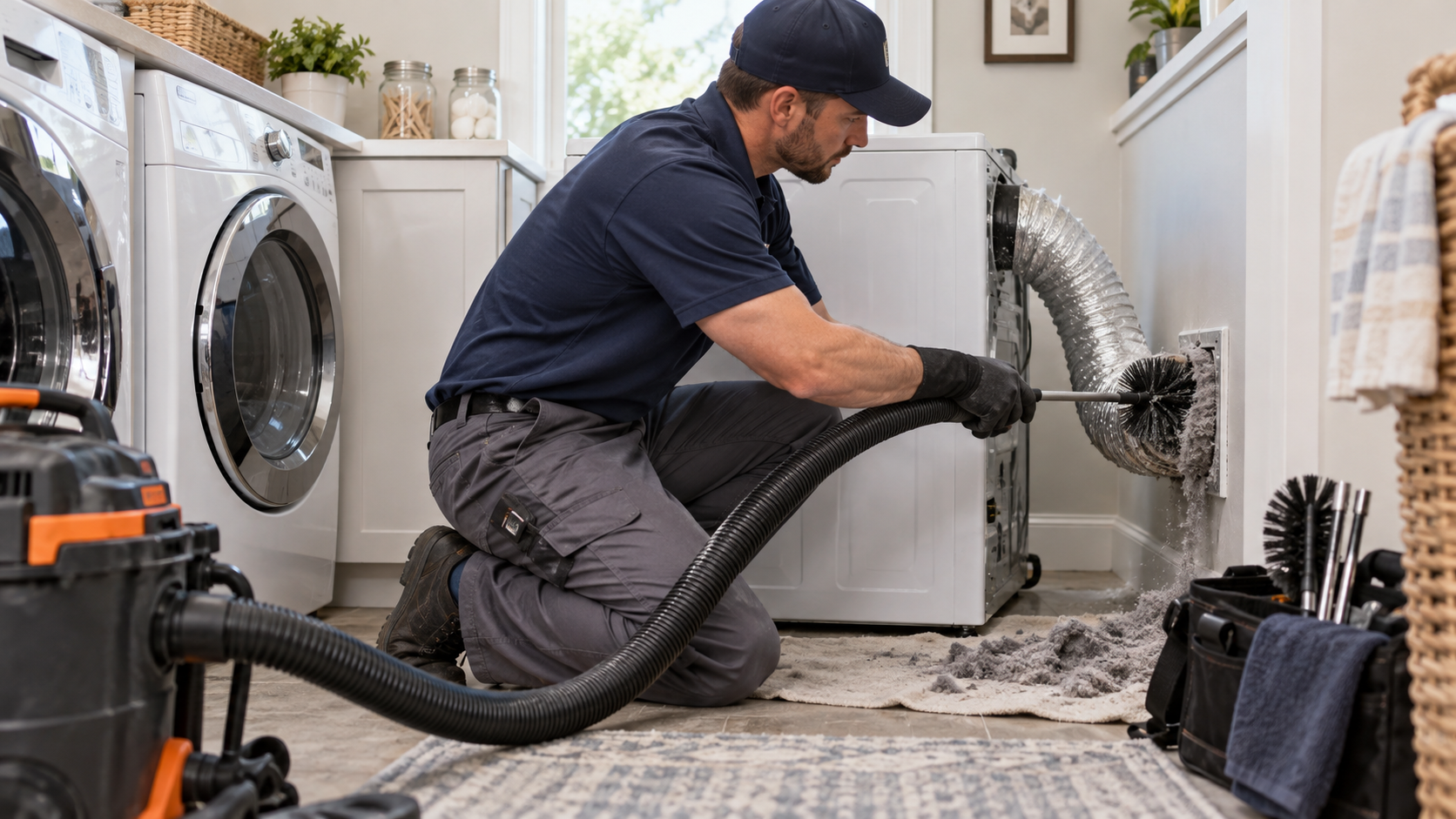
A professional service typically disconnects or accesses the duct, loosens lint inside the pipe with specialized brushes or rotating equipment, and removes debris using airflow or vacuum equipment.
The technician may also inspect the transition duct immediately behind the appliance, check that the exterior flap opens properly, and look for obvious damage, crushing, or disconnections.
Some companies measure airflow before and after cleaning. Others may inspect the duct with a camera when there is a suspected blockage or unusual vent path.
The exact process varies, so it is worth asking what is included before the appointment.
The Warning Signs Are Usually Pretty Ordinary
A clogged dryer vent rarely announces itself with a flashing warning sign saying, “Please clean me today.”
It usually starts with everyday annoyances.
- Clothes take noticeably longer than usual to dry
- A normal load needs a second drying cycle
- Clothes feel unusually hot when the cycle ends
- The dryer itself becomes very hot during operation
- The laundry room feels warmer or more humid than before
- You notice a hot, musty, or burning smell while drying clothes
- Lint collects around the dryer or behind the appliance
- The exterior vent flap barely opens when the dryer is running
- Airflow at the outdoor vent seems weak
- The dryer displays an airflow or vent warning on models equipped with one
Longer drying time is one of the most useful clues.
The CPSC specifically notes that clothes remaining damp after a normal cycle, or drying taking longer than it normally did, can point to a blocked lint screen or exhaust duct.
Of course, not every slow dryer has a dirty vent. A failing heating element, gas ignition problem, overloaded drum, damaged moisture sensor, or appliance malfunction can produce similar symptoms.
But checking airflow is a sensible place to start.
Why Does Lint Build Up If I Clean the Filter?
Because the lint filter is good, not perfect.
Some fine fibers pass through it. Hair and dust can follow. Fabric softener residue may make lint more likely to cling to surfaces.
Then the geometry of the vent matters.
Every elbow changes airflow. Long runs create more surface area. A crushed transition duct behind the dryer restricts air and creates places where lint can collect.
Vertical vents may also be more demanding because the dryer must push moist air upward before it reaches the roof.
Drying a lot of towels, bedding, pet blankets, and fleece can increase lint production too.
So yes, cleaning the lint screen after every load is essential. But it does not replace periodic cleaning of the rest of the exhaust path.
Why Dryer Vent Cleaning Is a Fire-Safety Issue
Dryers create heat. Lint burns easily. Restricted airflow can cause temperatures inside the system to rise.
That is a combination worth taking seriously.
The CPSC estimates an annual average of about 6,400 clothes-dryer fires in the United States, associated with roughly 180 injuries and about $105 million in property damage.
Meanwhile, U.S. Fire Administration data for 2018 through 2020 identified failure to clean as the leading contributing factor in home dryer fires, accounting for 31% of reported ignition factors.
This does not mean a slightly dusty dryer vent is about to set the house on fire tonight.
It means lint buildup is a preventable condition tied to a known household fire risk.
That is why federal safety guidance repeatedly focuses on three simple habits: clean the lint screen, keep the exhaust path clear, and make sure the outside vent can actually discharge air.
How Often Should Dryer Vents Be Cleaned?
For a typical home, once a year is a useful baseline.
The CPSC advises cleaning lint from the vent pipe at least annually, and the U.S. Fire Administration recommends yearly dryer-vent duct cleaning as part of home fire prevention.
But a calendar alone cannot tell you what your dryer needs.
A retired couple running three loads a week through a short six-foot duct may build lint much more slowly than a family of six doing two loads every day through a 25-foot roof vent.
You may need more frequent cleaning if the dryer gets heavy use, the duct is unusually long, there are several bends, you have pets that shed heavily, or you have already experienced vent blockages.
And if drying time suddenly increases six months after your last cleaning, you do not need to wait another six months just because the calendar says so.
Long Vents and Roof Vents Need Extra Attention
The shortest dryer exhaust path is usually the easiest one to maintain.
Unfortunately, modern home layouts do not always cooperate.
A first-floor laundry room on an exterior wall may have a short, almost straight run. A laundry closet in the center of a second floor may send the duct across a ceiling and up through the roof.
Longer ducts generally cost more to clean because there is simply more ductwork to reach.
Roof terminations also bring an access problem. A technician may need ladders, roof-safety equipment, or specialized tools.
If your dryer vents through the roof, the exterior cap also needs to stay clear. Debris, lint, or animal nesting around the termination can restrict airflow even when much of the duct itself is reasonably clean.
Birds Really Do Move Into Dryer Vents
A warm protected opening on the side of a house looks surprisingly attractive to some birds and small animals.
They do not care that it happens to be connected to your dryer.
Nesting material can block airflow quickly. You may hear scratching, notice debris around the exterior opening, or see that the vent flap no longer closes properly.
If an animal is actively nesting inside the vent, removal may need to be handled differently from ordinary lint cleaning. Wildlife protections can also apply to certain active bird nests, so this is not always a matter of grabbing the nearest shop vacuum.
After the obstruction is legally and safely removed, an appropriate exterior guard can reduce the chance of another animal moving in.
But the guard cannot restrict the dryer’s exhaust or become another lint trap.
What About the Hose Behind the Dryer?
That short connection matters more than it looks.
If the dryer is pushed hard against the wall, the transition duct can become crushed or kinked. Airflow drops, drying time rises, and lint has more opportunity to accumulate.
Federal safety material and appliance manufacturers commonly favor rigid or appropriate semi-rigid metal ducting rather than materials that restrict airflow or are not rated for dryer exhaust.
Your dryer’s installation manual is the right place to check the exact requirements for the appliance.
Also look at the connection whenever the dryer has been moved.
A perfectly clean vent does not work well if the first 18 inches behind the appliance are flattened almost shut.
Professional Cleaning vs. DIY
You can buy a dryer vent brush kit for around $15 to $50 and clean some vent systems yourself.
For a short, straight, easy-to-access vent, that can be a reasonable maintenance job.
The trouble begins when the duct is longer than expected, contains several turns, terminates on the roof, or has disconnected inside a wall.
| Situation | DIY May Be Reasonable | Professional Service Makes More Sense |
|---|---|---|
| Short straight wall vent | Often | If airflow stays weak after cleaning |
| Long concealed duct | Possible but harder | Usually easier to clean thoroughly |
| Roof termination | Not ideal for many homeowners | Safer access and proper equipment |
| Bird nest or major obstruction | Sometimes | Often preferable |
| Recurring blockage | May treat the symptom | Can inspect for design or duct problems |
| Damaged or disconnected duct | Depends on accessibility | Repair or rerouting may be needed |
If you do clean the vent yourself, disconnect power to the dryer before moving or servicing it and follow the appliance manufacturer’s instructions. Gas appliances deserve additional care because gas connections should not be disturbed casually.
And one little warning about rotary brush kits: do not assume more drill speed equals better cleaning.
A brush or rod that separates deep inside a hidden duct can turn a cheap Saturday project into a much more interesting Monday service call.
What Happens During a Professional Appointment?
A normal dryer vent cleaning service often takes around 30 to 60 minutes, although complicated systems can take longer.
The technician will usually identify the dryer vent path and locate the exterior termination first.
The dryer may be moved away from the wall so the transition duct can be inspected and disconnected. Cleaning equipment is then run through the exhaust duct to loosen lint and debris.
Depending on the company, a vacuum may collect loosened material or the system may be cleaned in a way that pushes debris toward an accessible end.
Afterward, the duct is reconnected, the dryer is run, and airflow may be checked outside.
A good technician should also tell you if something does not look right.
Maybe the duct is crushed. Maybe the route is extremely long. Maybe several unnecessary elbows are reducing airflow. Maybe the exterior termination is damaged or blocked.
Cleaning helps only so much if the vent itself was poorly installed.
When Cleaning Turns Into Vent Repair
Not every airflow problem is caused by lint.
A duct can separate inside a crawl space. Screws or damaged joints may catch debris. Flexible material can sag. An old exterior cap may stick closed. A section behind the dryer can become crushed.
In those cases, the better answer may be repair or rerouting rather than increasingly aggressive cleaning.
Current 2026 cost data puts many new dryer vent installations or replacements around $140 to $600, depending on duct length, material, access, and routing.
That is more expensive than cleaning, obviously.
But if the current vent has ten unnecessary turns and clogs every few months, fixing the route once may make more sense than paying to clean a bad design forever.
Your Outside Vent Is a Quick DIY Check
You do not need special equipment for one useful test.
Turn the dryer on and go outside to the exhaust termination.
The flap should open while the machine is running, and you should feel exhaust air leaving the vent.
CPSC and USFA safety guidance specifically recommends checking that the exterior vent opens properly.
If the flap barely moves, airflow feels unusually weak, or lint is collecting around the outlet, the vent may need attention.
Do not stick your hand or tools deep into an operating vent, obviously. You are simply checking whether air is leaving the house normally.
Things You Can Do Between Professional Cleanings
A professional dryer vent cleaning service should not be the only maintenance your dryer receives.
The small habits between appointments matter too.
- Clean the lint screen before or after every drying cycle
- Check pockets for tissues and other debris before washing clothes
- Do not run the dryer without its lint filter
- Keep the area behind and around the dryer reasonably clean
- Check that the transition duct is not crushed after moving the appliance
- Look outside occasionally while the dryer is running to confirm the vent opens
- Pay attention when normal loads begin taking longer to dry
- Follow the dryer manufacturer’s maintenance instructions
- Have unusual burning odors, overheating, or repeated airflow warnings investigated
These are small tasks, but they help you notice problems while they are still maintenance problems rather than emergency problems.
Does Dryer Vent Cleaning Lower Energy Use?
It can when restricted airflow has been making the dryer run longer than necessary.
Think about a load of towels that used to dry in 45 minutes but now takes 75.
The dryer is operating for an extra half hour every time you run that load.
Clear the restriction, restore normal airflow, and the machine may return closer to its previous drying time.
How much money that saves depends on the dryer, energy source, local utility rates, load size, and severity of the blockage.
So be cautious with contractors promising a specific percentage reduction on your electric or gas bill without measuring anything.
The realistic benefit is simpler: a dryer that can exhaust hot moist air properly generally does not need to work as long to dry the same laundry.
Can a Dirty Vent Damage the Dryer?
Restricted airflow can make the dryer operate hotter and longer.
That is not ideal for an appliance containing heating components, motors, sensors, belts, bearings, and electronics.
Cleaning a vent does not guarantee the machine will last 20 years, of course.
But asking an appliance to repeatedly run long, hot cycles because exhaust air cannot escape properly is hardly doing it a favor.
If drying performance suddenly gets worse, investigate rather than simply accepting longer cycle times as the dryer getting old.
Gas Dryers Deserve One Extra Note
A gas dryer produces combustion gases that must be exhausted outdoors correctly.
A restricted or disconnected exhaust system therefore deserves prompt attention.
If you smell gas, suspect a combustion problem, or have a carbon monoxide alarm, do not treat that as an ordinary vent-cleaning appointment. Leave the area as appropriate and follow your gas utility or emergency guidance.
Homes with fuel-burning appliances should also have properly located and maintained carbon monoxide alarms according to local requirements and manufacturer instructions.
The dryer vent itself is not the place for improvising with tape, random tubing, or a “temporary” indoor exhaust arrangement.
How to Choose a Dryer Vent Cleaning Service
This is one of those services where a suspiciously cheap price can turn into a surprisingly expensive appointment once the technician arrives.
Ask for the basic pricing structure upfront.
Does the quote include the entire vent from the dryer to the exterior? Is roof access extra? Is moving the appliance included? What happens if a bird nest is discovered?
Ask what equipment they use and whether they inspect the vent route before cleaning.
You can also ask whether minor duct repairs are included or quoted separately.
If the company claims your entire ventilation system is dangerous and immediately proposes thousands of dollars in unrelated work, you are allowed to get another opinion.
Dryer vent cleaning is usually a pretty straightforward service.
Be Careful With the $29 Cleaning Ad
Very low promotional prices are not automatically scams. Sometimes they are legitimate introductory offers.
But read what the price actually covers.
A teaser price may cover only a short standard vent, with extra charges for every additional foot, bend, second-floor access, roof termination, or other service.
By the time those extras are added, the total may look nothing like the advertisement.
Ask for an estimated total based on your vent location and home layout before scheduling.
A boring, transparent $145 quote is often nicer than an exciting $39 ad that becomes $350 at the front door.
Should You Combine Dryer Vent and Air Duct Cleaning?
They are separate systems.
Your HVAC ducts move heated or cooled air around the house. The dryer vent carries hot, moist laundry exhaust directly outdoors.
Some companies offer both services, and bundling can make sense if you independently need each one.
But your dryer vent needing cleaning does not automatically mean your HVAC ducts need cleaning too.
Treat them as two separate maintenance decisions rather than assuming one requires the other.
What If the Dryer Still Takes Forever After Cleaning?
Then you have learned something useful.
If airflow through the vent is confirmed to be good and clothing still takes unusually long to dry, the problem may be inside the appliance.
Electric dryers can develop heating-element problems. Gas dryers can have ignition or burner issues. Sensors may fail. A washer that is not spinning water out properly can also send unusually wet clothes into the dryer.
And sometimes the load is simply too large.
A vent cleaning service fixes the exhaust system. It cannot repair every possible dryer problem.
A reputable technician should not pretend otherwise.
Is Dryer Vent Cleaning Worth $100 to $200?
For most homes, it is not hard to justify.
At current prices, a standard vent cleaning often costs less than many appliance repair visits. It may restore airflow, shorten drying times when lint buildup is the cause, and addresses a maintenance issue specifically highlighted by federal fire-safety agencies.
The cost becomes especially easy to understand when you compare it with the consequences of a serious dryer fire.
Still, there is no reason to over-service a clean, short vent every three months.
Use the annual recommendation as a baseline and adjust according to how the system behaves, how heavily the dryer is used, and what the appliance manufacturer recommends.
FAQ
How much does a dryer vent cleaning service cost in 2026?
The national average is around $145. Standard basement or first-floor vents often cost about $80 to $150, second-floor vents about $110 to $185, and roof vents roughly $150 to $250. Long ducts, difficult access, nests, and repairs can increase the price.
How often should a dryer vent be professionally cleaned?
Annual cleaning is a useful baseline. The CPSC advises cleaning lint from the vent pipe at least once a year, and U.S. Fire Administration guidance also recommends yearly dryer-vent duct cleaning. Heavy use or complicated vent runs may need attention sooner.
How do I know if my dryer vent is clogged?
Common signs include longer drying times, unusually hot clothes, a hot dryer, weak airflow outside, a vent flap that barely opens, excess lint behind the appliance, burning odors, or an airflow warning from the dryer.
Can I clean a dryer vent myself?
Yes, particularly if the vent is short, straight, and easy to reach. Long runs, roof vents, several bends, recurring clogs, or suspected duct damage are better candidates for professional equipment and inspection.
Can a clogged dryer vent cause a fire?
Lint buildup and restricted airflow are recognized dryer-fire hazards. U.S. Fire Administration data identifies failure to clean as the leading factor contributing to ignition in home clothes-dryer fires for 2018 through 2020.
How long does professional dryer vent cleaning take?
Many straightforward cleanings take around 30 to 60 minutes. Long ducts, roof access, animal nests, heavy buildup, or repairs can make the appointment longer.
Will dryer vent cleaning make clothes dry faster?
It can if restricted airflow is causing the longer drying times. If the vent is already clear, slow drying may be caused by the dryer itself, unusually wet laundry, an oversized load, or another appliance problem.
Conclusion
A dryer vent is easy to forget because most of it is invisible.
You see the appliance. You see the lint filter. You see the clothes going in and coming out.
The duct disappearing into the wall barely gets a thought.
Until the towels stop drying.
That is why a dryer vent cleaning service belongs on the normal home-maintenance list rather than the emergency list. Current federal safety guidance recommends periodic vent cleaning, with yearly cleaning serving as a practical baseline for many households.
The price is usually manageable too. In 2026, a typical professional service averages around $145, with many ordinary first-floor jobs landing between $80 and $150. Roof vents, long duct runs, difficult access, and animal nests cost more.
But price is only part of the story.
Pay attention to the machine.
If a load that always dried in 45 minutes suddenly needs 75, something changed. If the dryer feels much hotter than normal, the exterior vent barely opens, or you smell something burning, do not simply keep adding time to the cycle.
Check the airflow.
Clean the lint filter every load. Keep the transition duct from getting crushed. Look at the exterior vent occasionally. Have the hidden duct cleaned periodically, and investigate recurring problems rather than repeatedly treating the symptom.
A properly vented dryer is wonderfully boring.
You put wet clothes in. They come out dry. Hot moist air leaves the house. Nobody thinks about airflow, lint, duct elbows, or roof caps.
And for a piece of home maintenance, boring is pretty much the perfect result.
Leave a Reply