
If you accidentally left a gas stove on without flame and suspect gas has escaped, leave the building with everyone else. Call 911 and your gas utility’s emergency line from a safe place outside. Do not stay beside the range trying to work out how much gas has accumulated.
This is advice for a US household. The emergency response comes first; appliance troubleshooting belongs later, after responders have said it is safe to return. Atmos Energy’s leak guidance tells customers to leave immediately and make the call from a safe distance. A faint smell is not a reason to postpone reporting a suspected leak.
What to do when an unlit burner may be releasing gas
- Get people and pets out, without delaying your exit to investigate the stove.
- Leave electrical controls alone. Do not switch lights, the range hood or fans on or off, unplug an appliance, use an igniter, or make a phone call inside the affected area.
- Once safely away, call 911 and the emergency number for the company that supplies your gas. Tell the dispatcher that an unlit stove burner may have been left on.
- Stay outside until the emergency responders say you may return. Tell them if someone is missing or anyone feels ill; do not go back into a suspected leak to search.
The California Public Utilities Commission’s emergency instructions warn against trying to control a suspected leak by turning valves or repairing damage. Do not move the range to reach a valve, relight anything, or test the gas supply yourself. Follow the emergency dispatcher’s instructions for your situation.
Should you open windows or run the extractor?
Do not make ventilation a task you must finish before leaving. Southern Connecticut Gas specifically advises against opening windows and doors to ventilate a suspected leak. Use the exit to get out; do not tour the home opening windows. Switching an electric extractor or fan can create an ignition source, so leave its controls untouched.
A kitchen’s size, open windows and the burner setting do not give you a reliable clearance time. Advice to wait five, fifteen or thirty minutes cannot tell you whether your particular home is safe. Report what happened and let the responding professionals assess it. If you have already turned the burner off or opened a window, still report the suspected release; those actions do not establish that the danger has passed.
No flame does not tell you exactly what failed
A dark burner is an observation, not a diagnosis. You cannot establish the condition of its valve or safety system simply by looking at the knob. Nor should you test other burners while a leak is suspected. Tell responders what you noticed before you left, including any smell, hissing, clicking or alarm.
After the emergency has been cleared, the model’s instructions become useful. In its surface-burner ignition guidance, GE Appliances describes moisture, blocked burner openings and incorrectly fitted caps as possible causes of ignition trouble. That guidance concerns particular appliance designs; it does not diagnose your stove from a distance or authorize cleaning during a leak.
A technician can check the ignition and gas controls when service is needed. Do not assume every modern cooktop has a device that automatically stops unburned gas, or that a particular flame-failure device has operated correctly. Keep the affected appliance out of use until its safety and any required repair have been addressed.
Unburned gas and carbon monoxide are different hazards
Carbon monoxide, or CO, is produced when fuel burns. The CDC’s explanation of CO poisoning includes gas ranges among possible sources of combustion fumes. An unlit burner releasing fuel is therefore a different situation from a burning appliance producing CO. Both require appropriate safety action; one should not be used to dismiss the other.
The CDC lists headache, dizziness, weakness, vomiting, chest pain and confusion among CO-poisoning symptoms. If someone feels unwell after a suspected gas or combustion incident, move outside and tell 911 about the symptoms. Do not remain indoors trying to decide which gas caused them or wait for an alarm to confirm your concern.
The Consumer Product Safety Commission advises immediate fresh air and prompt medical attention for suspected CO poisoning, even if an alarm has not sounded. If a CO alarm sounds, leave, call emergency services and wait for permission to reenter. A malfunctioning appliance identified as the source must be serviced before reuse.
Useful information for the call and the later service visit
From outside, give the dispatcher your address and describe the incident in ordinary terms: which appliance was involved, what you noticed and whether everyone is accounted for. Say if the stove uses propane rather than piped natural gas, if you know. If you do not know how long the knob was on, say so. Do not return for a photograph or a model number.
Once you are allowed back and the incident is over, keep the responder’s instructions and any service report. Record the stove’s make and model for the technician without pulling it away from the wall or disturbing its connector. Explain whether the problem followed cleaning, occurred on one burner, or has happened before. Those details are more useful than a guessed diagnosis such as “bad thermocouple.”
Prevention after the problem has been resolved
Read the operating and cleaning instructions for the exact range you own. Knobs, removable caps and ignition systems differ, so a universal push-and-turn direction is inappropriate. Have recurring ignition failures checked rather than repeatedly trying to light the burner.
CO alarms and fuel-gas detectors serve different purposes. Choose equipment for the gas it is intended to detect, and follow its installation and replacement instructions. Atmos notes that residential methane detectors are available but must not replace attention to leak warning signs. Do not assume a methane detector is also a propane or CO detector; check the product’s stated coverage.
For CO protection, the CPSC recommends alarms on every level and outside sleeping areas, installed according to the manufacturer’s instructions. It advises against placing them in kitchens or directly above fuel-burning appliances. Neither an alarm’s silence nor the absence of a noticeable smell is permission to ignore a suspected leak.
Questions homeowners often ask
What if it was only one burner for ten minutes?
Tell the dispatcher that estimate, but do not use it to decide that the release was harmless. There is no household waiting-time calculation in this guide. Leave and report a suspected leak.
Can I use the oven while the cooktop needs repair?
Ask the responding professional or qualified appliance technician before using the range again. An online description cannot establish that its other functions are safe.
Should I relight the pilot to see whether the problem is fixed?
No relighting or ignition attempts during a suspected leak. After the emergency is cleared, follow the instructions given by responders and the appliance manufacturer; unresolved faults need service.
Does this article replace the gas company’s instructions?
No. Follow the emergency dispatcher and the responders at your property. This guide explains why leaving and reporting the incident come before ventilation, cleaning or repair.
For non-emergency upkeep, see our home-maintenance articles.
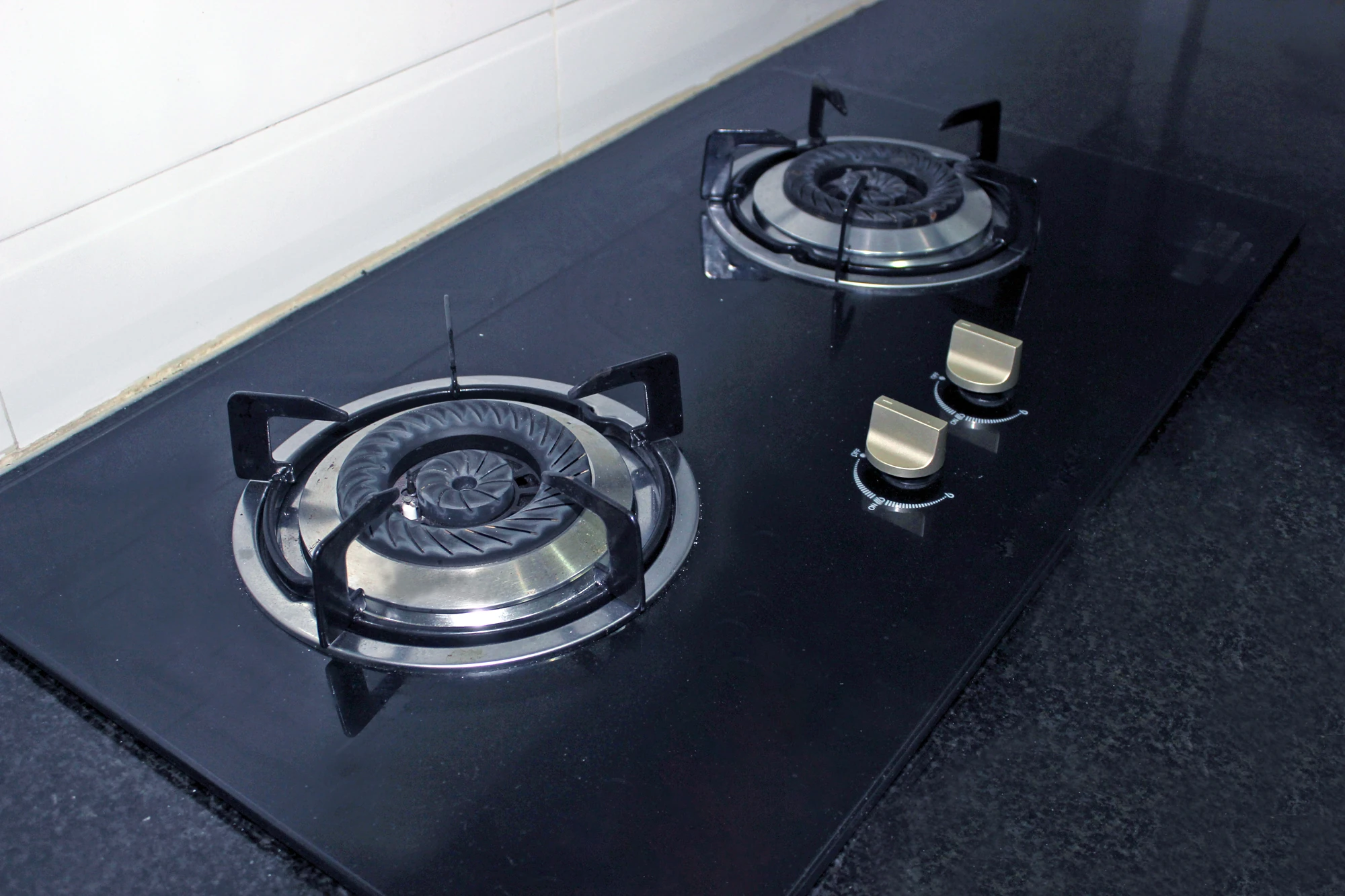
Illustrative photograph of an unlit gas cooktop, not a leak inspection or recommended installation: Pisethmao / Wikimedia Commons, 20 August 2013, CC BY-SA 4.0. Converted to WebP; same license.
Leave a Reply