
Asbestos removal services: what they actually do and when you need them
Older homes in the United States often hide a quiet hazard behind the walls, under the floor tiles, and around the ductwork. Asbestos was a common additive in building materials from the 1940s through the late 1970s, and it can still be found in attic insulation, vinyl sheet flooring, pipe wrap, ceiling texture, siding, and boiler insulation. When these materials are intact and undisturbed, the risk is generally low. The moment a remodel begins, a ceiling is scraped, or a pipe is cut, microscopic fibers can be released into the air. That is the moment when professional asbestos removal services become more than a line item on a quote: they become the difference between a safe renovation and a contamination problem that follows your family for years.
This guide walks through what licensed asbestos abatement actually involves, when a homeowner is legally and practically required to bring in a professional, how the work is priced, and how to evaluate a contractor before signing anything. It is written for property owners, renovators, and real estate buyers who want a clear, working understanding of the process rather than a sales pitch.
Why asbestos was used in the first place
To understand the abatement industry, it helps to know why the material ended up in so many buildings. Asbestos is a group of naturally occurring silicate minerals that separate into long, thin, flexible fibers. Those fibers resist heat, fire, electricity, and chemical corrosion, which made them attractive for everything from fireproofing to acoustic control.
Builders used asbestos in:
- Spray-applied fireproofing on structural steel and ceilings
- Insulation around boilers, pipes, ducts, and water heaters
- Vinyl floor tiles and the adhesive backing beneath sheet flooring
- Textured paint and “popcorn” ceiling treatments
- Roofing felt, shingles, and siding panels
- Joint compound used on drywall seams before the 1980s
- Cement sheets around fireplaces and behind tile walls
Many of these products are still in serviceable condition in homes built before roughly 1980. The U.S. Environmental Protection Agency and consumer safety agencies have documented the link between inhaling asbestos fibers and serious diseases, including asbestos-related lung conditions such as asbestosis, lung cancer, and mesothelioma. There is no safe exposure threshold that scientists have agreed on, which is the reason most modern regulations follow a “minimize exposure” approach rather than a “safe dose” model.
What professional asbestos removal services actually include
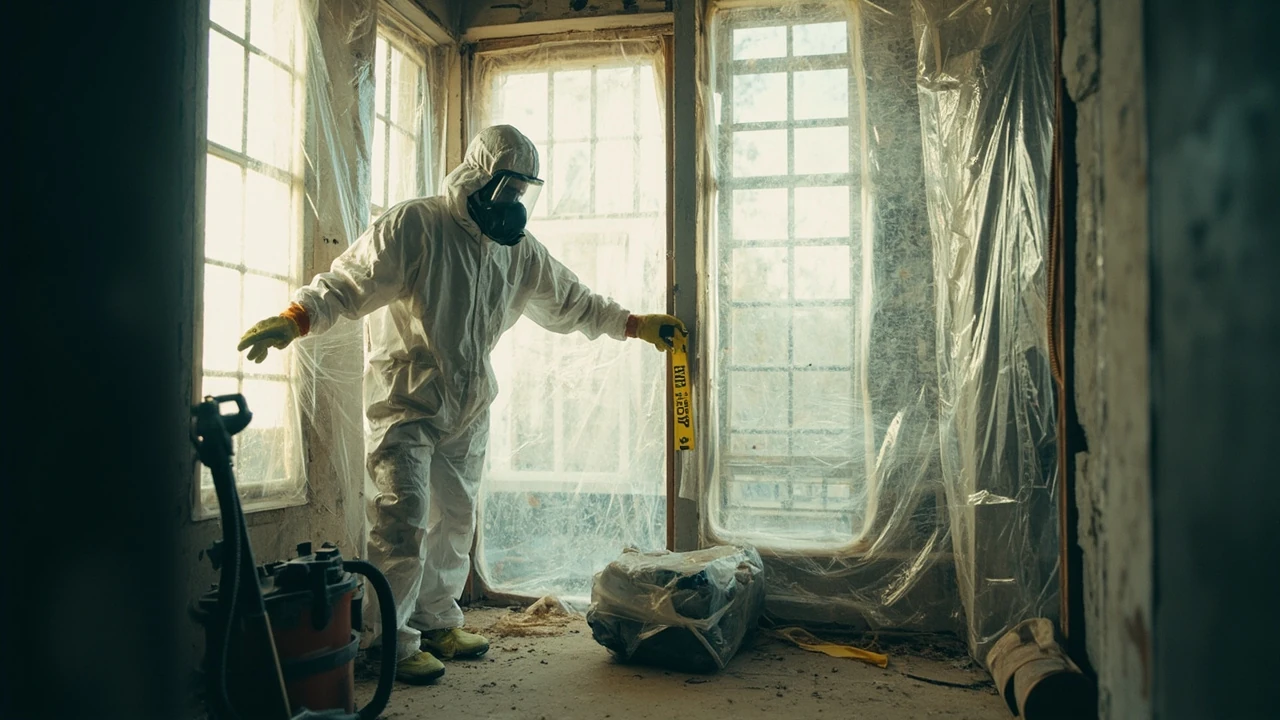
Licensed abatement is more controlled than a typical demolition. A qualified crew isolates the work area, removes the material without releasing fibers, disposes of the waste under regulated procedures, and verifies the space is clean before anyone enters without protection.
A standard residential job follows a predictable sequence:
- A pre-abatement inspection and bulk sampling, usually by an independent inspector, to confirm whether asbestos is present and which type it is.
- A written work plan, a notification to state or local agencies when required, and a contract from a licensed contractor.
- Setup of containment: critical barriers on walls and floors, negative-pressure air machines with HEPA filtration, and decontamination chambers for workers.
- Wet removal or careful dismantling so fibers stay bonded to water or encapsulant rather than becoming airborne.
- Sealed bagging of debris in labeled, leak-tight containers.
- Final visual inspection and aggressive air sampling by an independent third party.
- Documentation and waste manifests that prove lawful disposal at an approved landfill.
Homeowners sometimes confuse asbestos testing with asbestos abatement. They are different services, often performed by different firms. Testing identifies the problem; abatement solves it.
When you genuinely need a licensed contractor
Not every situation requires full abatement. The right answer depends on the material’s condition, the planned work, and local rules. A useful way to think about it is in three tiers.
| Scenario | Material condition | Typical recommendation |
|---|---|---|
| Suspected material, no renovation planned | Intact, undamaged, no plans to disturb | Leave in place; document location; inspect periodically |
| Suspected material, small repair planned (single tile, small patch) | Minor disturbance possible | Sample first; many jurisdictions allow licensed contractors to perform small-scale removal under a “minor project” rule |
| Suspected material, major renovation or demolition planned | Significant disturbance inevitable | Full-scale licensed abatement before any general contractor begins work |
| Damaged or crumbling material, any situation | Friable, releasing fibers | Treat as urgent; restrict access; hire abatement firm promptly |
The phrase “friable” matters here. Friable material can be crumbled, pulverized, or reduced to powder by hand pressure. Spray-on insulation, pipe wrap, and old ceiling texture are usually friable. Solid vinyl floor tiles and cement siding are usually non-friable, but they become friable the moment a saw, sander, or grinder touches them.
The role of state and federal rules
The federal government, through the EPA, sets baseline rules for asbestos work in schools and for renovation, repair, and painting (RRP) activities. The National Emission Standards for Hazardous Air Pollutants, commonly called NESHAP, governs how demolished structures are handled and how waste is tracked.
States often add stricter rules. A few patterns to expect:
- Most states require contractors performing abatement to hold a state license and to carry specific training certifications for workers and supervisors.
- Many states require a written notification several business days before any job above a small threshold.
- Some states require independent third-party air monitoring and clearance sampling rather than letting the abatement firm police itself.
- Local health or building departments may add permit requirements on top of state rules.
For homeowners, the practical takeaway is simple: confirm that your state licenses the contractor, confirm that the contract specifies who is responsible for notifications and clearance sampling, and keep copies of every document. A good firm will explain this without being asked.
How much asbestos removal services cost
Costs vary widely because the work is project-specific. Square footage, material type, access, and clearance requirements all move the number. Rather than memorizing a single price, it is more useful to understand the cost drivers and the typical ranges homeowners report.
| Project type | Typical scope | Reported homeowner range | Main cost drivers |
|---|---|---|---|
| Single-room pipe wrap or small patch | Localized, contained work area | Lower four figures | Setup time, crew size, waste volume |
| Full attic insulation (loose fill or batts) | Whole attic, often full containment | Mid four figures and up | Square footage, height, complexity |
| Popcorn ceiling texture across one floor | Continuous material, large footprint | Mid to upper four figures per floor | Square footage, paint encapsulation, ceiling height |
| Whole-house abatement before gut renovation | Multiple materials, multiple rooms | Five figures and above | Material mix, square footage, structural access, disposal |
A few notes that often surprise first-time clients:
- Testing is usually billed separately from removal. Independent inspection and lab analysis are typically priced per sample, not per job.
- Re-insulation, drywall repair, or repainting after abatement is not part of the abatement contract. Those costs sit on the general contractor’s side of the budget.
- Emergency or expedited scheduling carries a premium, especially if a crew must displace other work.
- Travel distance matters. Remote properties can add mobilization fees on top of standard rates.
Get at least three written quotes from licensed contractors. Be cautious of any bid that is dramatically lower than the others: in this trade, the cheapest price often signals missing insurance, missing notifications, or a crew that will not actually establish containment.
How to evaluate a contractor before signing
For additional context, Asbestos abatement is one of the few trades where a bad contractor can create a long-term health liability rather than a cosmetic problem. Vetting is worth the time. A reasonable checklist:
- State asbestos contractor license, current and verifiable against the issuing agency’s online database.
- Proof of workers’ compensation and general liability insurance that specifically covers abatement work.
- Supervisor accreditation through a recognized training provider; workers should also hold current training cards.
- A written work plan that names the materials, the methods, the containment strategy, and the decontamination setup.
- Clarity on who handles notifications, air monitoring, and clearance sampling.
- A waste disposal plan that includes the receiving landfill and a copy of the waste manifest after the job.
- References from comparable projects, ideally homes built in the same era as yours.
If a contractor resists showing documents, pushes verbal-only agreements, or pressures you to skip sampling before starting work, walk away. Sampling is not optional when the material is unknown, and a serious firm will not find it insulting that you asked.
What homeowners often get wrong
Even motivated owners make predictable mistakes. A few worth calling out:
- Treating a home test kit as confirmation. Consumer-grade kits can mislead because false negatives are common when the wrong patch of material is sampled. A certified inspector with proper chain-of-custody samples is more reliable.
- Letting a general contractor “handle it.” General contractors, even excellent ones, are rarely licensed to perform abatement. They can coordinate the work; they should not be the ones scraping the ceiling or bagging the pipe wrap.
- Pulling up old vinyl tile without wetting it first. Dry removal is the single most common cause of fiber release in DIY scenarios.
- Skipping re-occupancy air clearance to save a day. Without clearance sampling, there is no documented evidence that the space is safe to live in.
The first two of these are the most expensive. If there is any chance asbestos is in the work area, the correct sequence is sample, plan, then abate. Reversing the order tends to spread contamination throughout the rest of the house.
What to expect on the day of the job
A well-run abatement project looks almost boring, and that is the point. A few things you should see when the crew arrives:
- Workers in fitted respirators, disposable coveralls, and boot covers from the moment they enter the property.
- Plastic sheeting sealed at every doorway, window, and HVAC return that leads into the work area.
- A negative-pressure machine running, with a pressure differential confirmed before cutting begins.
- Visible wetting of the material or a surfactant applied before any disturbance.
- A clean room and a dirty room separated by taped seams, with a shower or wash station where required.
- Sealed, labeled waste bags leaving the site at the end of each shift, not accumulating in the living area.
The job may look slower than a typical remodel. That is intentional. Speed is the enemy of clean abatement, and the right crew will explain what they are doing as they go.
Asbestos and renovation projects: a planning checklist
For homeowners lining up a remodel in an older property, a short checklist reduces the chance of mid-project surprises:
- Pull the original build year and any renovation records. Material lists are not always available, but age is a strong hint.
- Have a certified inspector sample anything that will be disturbed, before the general contractor finalizes the scope.
- Insert an abatement line item in the construction budget even if the result is “no asbestos found.” The cost of the inspection is small compared with the cost of an unplanned halt.
- Schedule abatement before demolition, never in parallel with it.
- Require written clearance reports before any non-abatement trade enters the work area.
This sequence keeps the rest of the renovation on schedule, and it gives you documentation that the home was checked before major work began.
What asbestos removal services are not designed to do
It is also worth naming what abatement does not cover, since confusion here is common:
- It does not usually include rebuilding. Drywall, insulation replacement, and paint are separate scopes and trades.
- It does not certify a home as “asbestos free.” A certified inspector can state that the sampled materials did not contain asbestos, not that no asbestos exists in the structure.
- It does not cover non-friable roofing or siding removed by a roofing crew using standard methods, though some states do require a roofing contractor to follow specific rules for those materials.
- It does not replace routine maintenance. Caulking, encapsulating, and sealing can be appropriate alternatives when removal would damage a still-serviceable material.
Encapsulation, the process of sealing a material with a coating that binds fibers in place, is sometimes a legitimate alternative to full removal. The choice between encapsulation and removal depends on the material, its condition, and the planned use of the space. A licensed contractor can outline both options, with the costs and trade-offs of each, so you can make an informed decision.
Documentation to keep after the job
Treat the file the contractor hands you the way you would treat a car title. It protects you during a future sale, a future renovation, and any insurance question. The standard file includes:
- The pre-abatement inspection report and laboratory results
- The contractor’s license and insurance certificates at the time of work
- Notifications sent to state or local agencies
- Daily logs, if the job ran more than one shift
- Final visual inspection and air clearance reports
- The waste manifest with the receiving landfill information
If you cannot locate any of these for past work, the next contractor on the property can still move forward, but the missing paperwork will be a question during any future sale disclosure.
What real abatement firms emphasize in their work
Industry descriptions of the trade tend to highlight the same themes: trained personnel, full containment, and verifiable cleanup. One long-running abatement firm, for example, summarizes its practice by noting that extensive safety measures are required to ensure safe asbestos removal when abatement is needed, and that experienced supervisors and crews perform the work under controlled conditions for commercial, government, industrial, and residential clients. That framing reflects the broader industry: training, containment, and documented cleanup are not optional extras, they are the work itself.
Red flags when comparing quotes
Price is a real factor in any home project, but a few patterns suggest a contractor is cutting corners. Treat the following as reasons to slow down and ask more questions:
- A quote that excludes testing, notifications, and clearance sampling. Those are not optional in most jurisdictions.
- A timeline that promises to finish an entire attic in a single day with a two-person crew. Abatement is labor-intensive.
- Vague disposal language. The waste manifest is a legal document and should be part of the deliverable.
- Cash-only invoicing or pressure to start before paperwork is signed.
- No verifiable business address, or a phone number that routes through a call center rather than a local office.
Any one of these by itself is not proof of a problem. Several of them together usually are.
The short version: what to do next
If you are weighing asbestos removal services for a real project, the path forward is shorter than it looks. Identify the materials in question, hire a certified inspector to sample them, and only then ask licensed contractors for bids. Build the budget around the realistic range for your scope rather than a single number, and keep every report. With those steps in place, the rest of the project, whether a single room or a whole-house renovation, has a much better chance of finishing on time, on budget, and with the home as clean at the end as it was at the start.
Frequently asked questions
How do I know if my home has asbestos?
The most reliable way is to hire a certified asbestos inspector to take bulk samples following proper chain-of-custody procedures. The age of the home is a strong hint: structures built before 1980 are more likely to contain asbestos in common materials, but visual inspection alone cannot confirm or rule it out.
Do I always need a professional for asbestos removal services?
For anything beyond very small, well-contained tasks, yes. Most states require licensed contractors for abatement work, especially for friable materials. Even where DIY is technically legal, the risks of releasing fibers into shared HVAC systems or family living space are high enough that professional work is usually the safer and more cost-effective choice.
How long does a typical residential asbestos job take?
A small, single-room project can take one to three days of active work, plus setup and clearance. A whole-house abatement can run from one to several weeks, depending on the materials, square footage, and required air monitoring. The contractor’s written schedule should break setup, removal, cleanup, and clearance into separate phases.
Is asbestos safe if it is not being disturbed?
Intact, undisturbed asbestos-containing material generally poses a lower risk than damaged or crumbling material. Most health agencies recommend managing it in place rather than removing it preemptively, as long as it remains in good condition and is not going to be touched during upcoming work. Periodic visual checks are a sensible precaution.
What is the difference between asbestos abatement and asbestos remediation?
In common usage, the two terms overlap. Abatement specifically refers to actions that reduce or eliminate asbestos hazards, which can include removal, encapsulation, or enclosure. Remediation is a broader term that also covers cleanup after a release. When hiring, ask the contractor exactly which approach they recommend and why it fits your situation.
Will my homeowners insurance cover asbestos removal services?
Standard homeowners policies usually treat asbestos as a maintenance issue rather than a covered peril, so removal is generally not reimbursed. Coverage can change when the work is tied to a covered loss, such as a fire or certain water damage events. Read your policy and ask your insurance agent directly before assuming any coverage.
Can I stay in the house during abatement?
It depends on the scope and the location of the work area. Many residential projects allow the family to remain in the home as long as containment holds and HVAC is isolated from the work area. For large or whole-house jobs, temporary relocation is often the safer and less stressful option. The contractor should give a specific recommendation based on the work plan.
What should I do if I think asbestos has been released in my home?
Stop the activity that disturbed the material, leave the area, and close doors or cover the space if you can do so quickly and safely. Do not attempt to vacuum or sweep. Contact a licensed asbestos abatement contractor to assess the situation and arrange professional cleanup. Keep records of who was in the area and for how long, in case a future medical question arises.
How do I verify a contractor’s license and training?
Start with the state agency that licenses asbestos contractors, which is usually a department of health, environment, or labor. Most states maintain a searchable online database. Ask the contractor for copies of supervisor and worker training certificates, then confirm the certificates come from an accredited training provider. The EPA also maintains a model program and a list of accredited providers.
Is it worth removing asbestos before selling a house?
Often no, if the material is intact and documented. Buyers typically focus on the condition of known materials and on the documentation that supports the disclosure. Removing asbestos just to remove it can be expensive and unnecessary. A pre-listing inspection and a clean disclosure file, by contrast, can reduce friction during the sale without the cost of full abatement.
Leave a Reply