


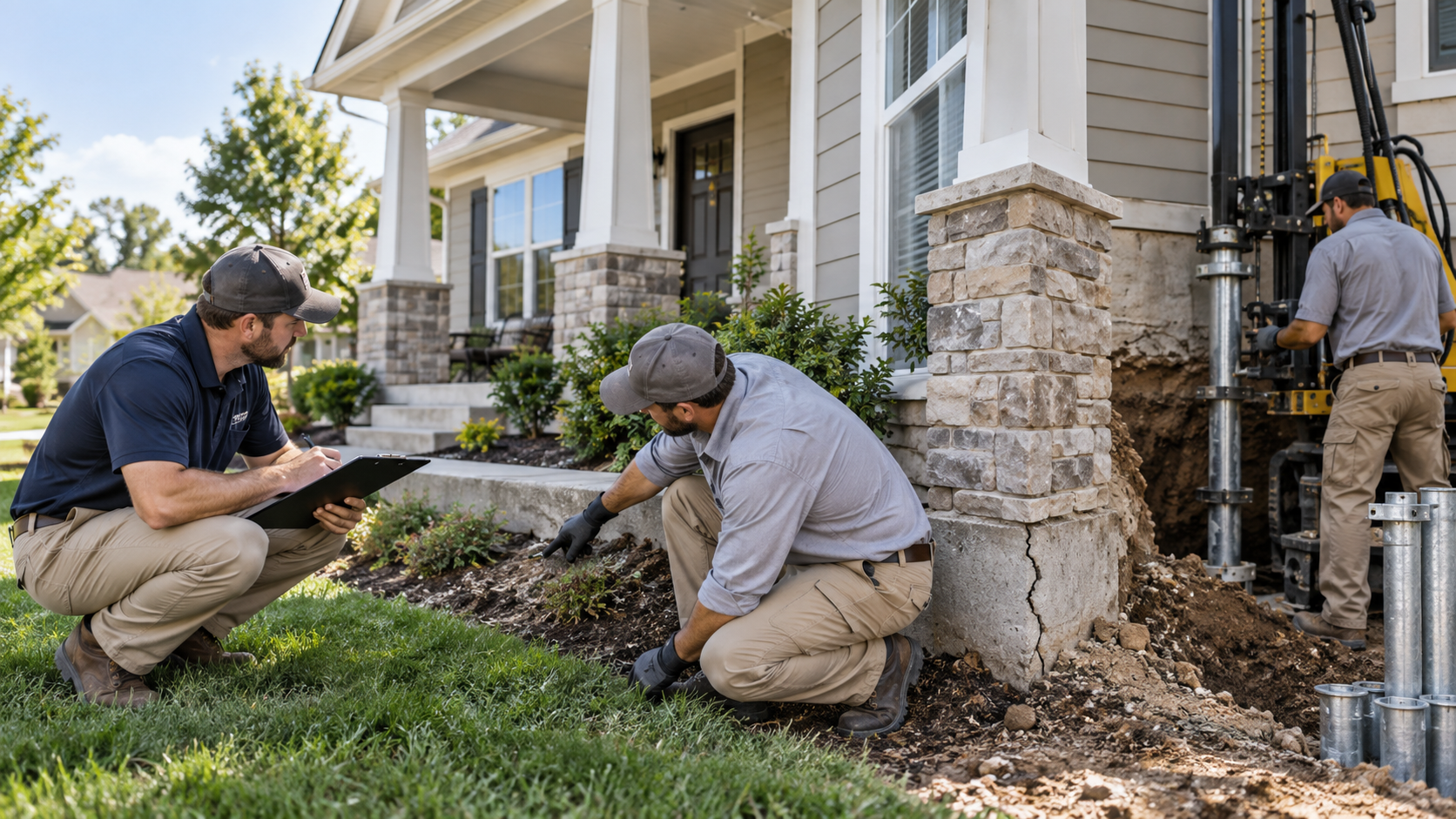
A crack appears above the living room window. Then a bedroom door starts sticking. A few months later, you notice the floor feels slightly lower near one corner of the house.
At that point, Googling the best foundation repair companies feels a lot less casual.
Foundation work can cost anywhere from a few hundred dollars for a minor crack to tens of thousands for major settlement, underpinning, wall stabilization, or lifting. And unlike repainting a bedroom, this is not a project where a mediocre result is easy to redo next weekend.
The contractor matters.
For 2026, several companies stand out because of their established service networks, foundation-specific experience, repair systems, warranties, or strong regional presence. Groundworks and Ram Jack are among the broadest choices. Olshan has decades of experience and a particularly deep presence in areas where shifting soils are common. Thrasher and Acculevel are strong regional options, while Basement Systems connects homeowners with local contractors for foundation, basement, and crawl-space problems.
But there is a catch.
The “best” foundation company nationally may not be the best company for your house.
Soil in Houston behaves differently from soil in Denver. A crawl-space foundation in Indiana does not fail exactly like a concrete slab in Texas. Local crew quality, engineering, drainage knowledge, permits, warranty service, and the proposed repair method matter just as much as the logo on the truck.
Here is how the major names compare – and how to figure out which one deserves your money.
Best Foundation Repair Companies at a Glance
| Company | Best For | Coverage | Worth Knowing |
|---|---|---|---|
| Groundworks | Broad foundation, crawl-space, waterproofing, and concrete solutions | Large multi-state U.S. network | Nationally backed warranties and many regional brands |
| Ram Jack | Pier systems and serious settlement problems | 70+ locations through a dealer network | Foundation-focused systems and transferable limited lifetime warranty options |
| Olshan Foundation Solutions | Settlement and expansive-soil problems | Multiple states with a strong Southern presence | Operating since 1933 and offers several warranty levels |
| Thrasher Foundation Repair | Midwest and Plains homes | Nebraska, Iowa, Missouri, Kansas, Illinois, Colorado | Foundation repair plus waterproofing and concrete services |
| Acculevel | Midwest foundation, crawl-space, and basement issues | IN, IL, KY, MI, WI, MO, IA, OH, PA, VA | Family-owned since 1996 with broad regional coverage |
| Basement Systems Network | Homes with both foundation and basement moisture problems | Large U.S. and Canadian dealer network | Services are provided through local independent contractors |
This is not a “number one wins everywhere” ranking.
Think of it as a shortlist.
Your next step should be comparing the local operation serving your ZIP code, the diagnosis they give you, and the repair plan they propose.
Groundworks: Best All-Around National Option
Groundworks has become one of the biggest names in residential foundation repair in the United States.
The company operates through Groundworks locations and numerous regional brands. Depending on where you live, the truck in your driveway may carry a local name rather than simply saying Groundworks.
That model gives the company broad geographic reach while maintaining regional operations.
The biggest advantage is that foundation repair is only one part of what the network handles. Groundworks companies commonly work on foundation settlement, basement waterproofing, crawl-space problems, concrete lifting, and related moisture issues.
That can matter because foundation trouble does not always arrive alone.
Imagine a house with settlement on one side, a damp crawl space, poor yard drainage, and sinking concrete near the foundation. Hiring three unrelated contractors can turn the project into a game of “not our problem.”
A company that works across several of those areas may be able to look at the house more broadly.
Groundworks also emphasizes nationally backed warranties. Many installed solutions have warranties that remain with the property and can transfer when the house is sold, although the exact coverage depends on the product and contract.
Still, a large national company is not automatically perfect.
Local experience matters. Ask who will perform the inspection, whether the installation crew works directly for the local operation, what repair system is being proposed, and exactly what the warranty covers.
Ram Jack: A Strong Choice for Piering and Settlement
Ram Jack is another name homeowners frequently encounter when researching the best foundation repair companies.
The company has more than 70 locations and works through independently owned local dealers. Its services focus heavily on structural foundation repair and pier systems, including driven and helical piles.
That makes Ram Jack particularly relevant when the problem is not just a cosmetic crack but actual foundation settlement.
Piers are installed beneath a settling foundation to transfer the home’s weight to stronger soil or load-bearing material deeper underground. The exact system and depth depend on the property, soil, structure, and engineering requirements.
Ram Jack’s own 2026 guidance notes just how broad foundation costs can be: small crack repairs may start around a few hundred dollars, while significant structural work can reach $30,000 or more.
That is why the diagnosis matters more than the brand name.
One thing to remember about Ram Jack is that local locations are independently operated. Services, project experience, pricing, and some warranty details can therefore vary.
The company’s foundation repairs may include a limited lifetime transferable warranty, but read the actual local contract rather than assuming “lifetime” means every future movement anywhere on the house is covered forever.
Foundation warranties almost always have boundaries.
Olshan Foundation Solutions: Decades of Experience
Olshan is the old-timer in this group.
The company dates back to 1933 and has developed a particularly familiar name in Texas and the southern United States, where expansive clay soil can create serious foundation movement.
Its current service network extends well beyond Texas, with locations in numerous states including parts of the South, Midwest, Colorado, Florida, North Carolina, Ohio, Virginia, and others.
Olshan handles foundation repair along with services such as drainage, waterproofing, crawl-space work, wall repair, and concrete-related repairs in many markets.
The company also offers different warranty arrangements depending on the work performed.
An available lifetime transferable warranty applies to certain qualifying repair systems and repaired areas. Transfer conditions matter: homeowners may need to provide paperwork and complete the transfer process after a property sale.
This is exactly why warranty language should be read before signing a foundation contract.
“Lifetime transferable warranty” sounds fantastic in a sales conversation.
You still want to know whose lifetime, what transfers, whether fees apply, which piers or areas are covered, whether annual service is required, and what happens when movement appears six feet beyond the original repair zone.
Thrasher: A Strong Regional Pick in the Midwest and Plains
Sometimes the better company is not the largest company.
Thrasher Foundation Repair serves homeowners across Nebraska, Iowa, Missouri, Kansas, Illinois, and Colorado.
That geographic focus makes it worth considering for homes in the central U.S., where expansive soils, basement-wall movement, seasonal moisture, and freeze-thaw conditions can all create foundation problems.
Thrasher works on foundation repair, basement waterproofing, drainage, and concrete repair.
For homeowners with a basement that is both moving and taking on water, that combination can be useful.
A horizontal basement-wall crack, for example, may be a structural issue rather than simply a waterproofing problem. Sealing the crack without addressing wall movement would be treating the symptom.
This is where a company that understands both structure and moisture can make a difference.
Thrasher is not available nationwide, so this recommendation only matters if you are inside its service territory.
And honestly, that is fine.
A regional company that understands the soil beneath your neighborhood may be more useful than a famous national name that barely operates locally.
Acculevel: Another Regional Company Worth Comparing
Acculevel started in Indiana in 1996 and has expanded substantially across the Midwest and nearby states.
Its current service territory includes Indiana, Illinois, Kentucky, Michigan, Wisconsin, Missouri, Iowa, Ohio, Pennsylvania, and Virginia.
The company works on foundation repair, basements, crawl spaces, concrete leveling, sump pumps, and related home-structure problems.
That makes Acculevel particularly relevant for pier-and-beam homes, sagging floors, damp crawl spaces, wall cracks, settlement, and basement problems.
Again, the main appeal is local and regional familiarity.
A contractor that regularly works on the same style of houses, soils, basements, and crawl spaces in your area has probably seen your problem before.
That does not mean you skip comparison shopping.
Get more than one diagnosis.
If one company says the house needs 18 piers and another says drainage correction plus six piers will stabilize the affected area, you now have a very important question to investigate before signing a five-figure contract.
Basement Systems: Useful When Water and Structure Overlap
Basement Systems works differently from a traditional single foundation company.
It operates through a large network of local contractors across the United States and Canada. Individual dealers provide foundation repair, basement waterproofing, crawl-space solutions, and related services.
The network can be useful for homeowners whose foundation problems involve basement walls or chronic moisture.
But remember: you are hiring the local contractor.
Warranty terms vary by product and service, and Basement Systems itself advises homeowners to confirm warranty information with the authorized local contractor.
That is worth repeating because national marketing can make dealer networks feel more uniform than they really are.
Check the exact business that will be working on your house.
How Much Does Foundation Repair Cost in 2026?
This is where foundation repair gets uncomfortable.
The national average currently sits around $5,175, with many projects falling between roughly $2,225 and $8,133.
But an average does not tell you much when the possible projects range from sealing one crack to installing deep steel piers beneath half a house.
Minor non-structural cracks may cost only a few hundred dollars. Settlement, bowed basement walls, significant leaks, and major underpinning can reach $10,000, $20,000, or more.
| Foundation Problem or Repair | Typical 2026 Cost Range |
|---|---|
| Minor foundation crack | About $250-$800 |
| Foundation leak | About $2,000-$12,000 |
| Moderate settlement or sinking | About $4,500-$20,000 |
| Bowed foundation wall | About $5,000-$15,000 |
| Pier-and-beam repair | About $1,500-$15,000+ |
| Underpinning or extensive piering | Often $10,000-$20,000+ |
| Major house lifting or severe repair | $20,000-$40,000+ |
There is another reason quotes vary.
Two contractors may recommend completely different repair methods.
One may propose helical piers. Another may specify push piers. A third may decide the movement is minor and recommend drainage correction and monitoring before structural work.
Those are not comparable quotes yet.
You need to compare the diagnosis first.
Signs You Should Call a Foundation Repair Company
Not every crack means your house is sinking.
Concrete shrinks. Drywall moves. Wood framing responds to humidity. Houses settle a little over time.
But some patterns deserve professional attention.
- Stair-step cracks running through brick or masonry joints
- Foundation cracks that are widening or changing
- Doors or windows that suddenly begin sticking
- Floors that slope, dip, or feel noticeably uneven
- Large gaps around windows, doors, trim, or cabinets
- A chimney pulling away from the house
- Bowed or leaning basement walls
- Cracks appearing repeatedly after cosmetic repairs
- Sections of the house that appear to be sinking or separating
- Water intrusion combined with visible foundation movement
One small drywall crack may mean very little.
Three of these symptoms appearing together are harder to dismiss.
Do You Need a Structural Engineer?
Sometimes hiring an independent structural engineer before accepting a major foundation proposal is money well spent.
There is an important difference between a contractor and an independent engineer.
A foundation contractor inspects the house and may also sell the repair.
An independent structural engineer is normally being paid for the evaluation itself.
If three contractors disagree wildly, an engineer can provide another perspective on whether the movement is structural, how serious it is, and what type of stabilization may be appropriate.
Current U.S. pricing often puts structural engineering around $200 per hour, although inspection fees vary.
Spending several hundred dollars for independent advice before approving a $25,000 foundation project can be perfectly rational.
The Cheapest Quote Can Be the Most Expensive Quote
Imagine three estimates.
Company A: $7,500.
Company B: $12,000.
Company C: $18,500.
It is tempting to decide the first company is the obvious winner.
But maybe Company A is installing eight shallow supports. Company B is installing eight engineered piers to a verified load. Company C has also included drainage correction, excavation, wall stabilization, permits, and repair of a second affected section.
Those are three different projects.
Foundation estimates need detail.
How to Vet Foundation Repair Companies
This is a structural repair. Take the vetting process seriously.
A good company should be able to explain what moved, why it probably moved, what the repair is designed to accomplish, and what the repair cannot promise.
You should also understand exactly who is responsible if something goes wrong later.
- Confirm the company is properly licensed where your state or locality requires it
- Ask for proof of liability insurance and workers’ compensation coverage
- Check how long the local operation has actually worked in your area
- Compare recent reviews for the specific local branch, not only the national brand
- Ask whether employees or subcontractors will perform the work
- Request the proposed pier, anchor, wall, drainage, or stabilization system in writing
- Ask whether engineering is included or required
- Read the actual warranty before paying a deposit
- Check whether the warranty transfers to a future homeowner and under what conditions
- Get at least two or three opinions for major structural work
If the salesperson seems annoyed by those questions, that is information too.
What Does “Lifetime Warranty” Really Mean?
The phrase sounds much simpler than the contract usually is.
A lifetime foundation warranty normally does not mean the company will fix every future foundation problem throughout the entire property at no charge.
It may cover only installed piers, specific repaired sections, certain types of movement, or adjustments to a particular system.
There may be transfer rules when the house is sold.
There may be maintenance requirements.
Drainage changes, additions, plumbing leaks, earthquakes, flooding, landscaping, excavation, or movement outside the original repair zone may have their own exclusions.
This is not necessarily a bad warranty.
It is simply a contract.
Read it like one.
Push Piers or Helical Piers?
These terms come up constantly in foundation estimates.
Push piers are steel sections hydraulically driven into the ground using the weight of the structure until they reach competent load-bearing material or the required resistance.
Helical piers look more like giant steel screws. They are rotated into the ground and can be installed according to torque and engineering requirements.
Both systems can be appropriate.
The better question is not “Which one is always best?”
It is “Why is this system appropriate for my soil, foundation, load, and repair location?”
A contractor should have an answer better than “this is what we always install.”
Do All Cracks Need Structural Repair?
No.
Concrete can crack as it cures and shrinks. Small vertical cracks may be cosmetic or may simply need sealing against water.
Horizontal cracks, large diagonal cracks, stair-step masonry cracking, and cracks combined with measurable displacement deserve more attention.
The width of a crack matters, but movement matters more.
A tiny crack that doubles in width over six months tells you more than an old stable crack that has looked identical for 20 years.
Take dated photos and measurements if you are monitoring a questionable area.
Foundation Problems Often Start With Water
Here is the part that gets overlooked because steel piers sound much more impressive than gutters.
Water changes soil.
Expansive clay can swell when wet and shrink when dry. Poor drainage can erode or soften soil. Plumbing leaks beneath slabs can change moisture conditions. Downspouts dumping water beside the house can create local trouble.
So the smartest foundation repair plan may include drainage work.
If a contractor proposes $15,000 in stabilization while ignoring a broken downspout that has poured roof water beside the same corner for ten years, ask why.
Structural repair and water management often belong in the same conversation.
Questions to Ask Before Signing the Contract
You do not need to become a structural engineer overnight.
You just need the contractor to explain the repair clearly enough that you understand what you are buying.
- What evidence shows that this part of the foundation is moving?
- What do you believe caused the movement?
- Is the goal to stabilize the foundation or lift it?
- How many piers, anchors, straps, or supports are included?
- Why was this specific repair method selected?
- What happens if load-bearing soil is deeper than expected?
- Are permits, engineering, excavation, cleanup, and landscaping included?
- Could plumbing or utility lines be affected by lifting the structure?
- What exactly is covered under the warranty?
- What work is specifically excluded from the estimate?
Get those answers in writing where possible.
Beware of the “We Have to Fix It Today” Sales Pitch
A severely unstable structure can require urgent action.
Most residential foundation problems are not discovered at 10 a.m. and destined to collapse at 4 p.m.
If someone offers a huge same-day discount only if you sign immediately, be careful.
You are allowed to understand the diagnosis.
You are allowed to get another quote.
You are allowed to hire an engineer.
You are allowed to read the warranty overnight.
Pressure is not engineering.
Local Expertise May Beat a National Brand
This deserves its own section because people searching for the best foundation repair companies often focus too heavily on national names.
A local contractor may be the better option.
A company that has repaired slab foundations in Dallas clay for 30 years may understand those conditions better than a large organization that entered the market recently.
The same applies to basement walls in the Midwest, crawl spaces in the Southeast, and hillside foundations in parts of the West.
National size gives you resources and warranty infrastructure.
Local depth gives you soil and construction knowledge.
The ideal contractor has both.
What About Online Reviews?
Reviews help, but foundation repair is a funny category.
A customer can be delighted on installation day and have no idea whether the repair will perform correctly in ten years.
That does not make reviews useless.
They are excellent for identifying patterns around communication, cleanup, punctuality, warranty service, pressure tactics, change orders, and whether the company responds after receiving payment.
Look especially at recent reviews describing warranty claims.
How a contractor behaves five years after the original job can tell you more than how friendly the salesperson was during the estimate.
How Long Does Foundation Repair Take?
Minor crack repairs may be completed in a few hours.
A pier installation may take several days. Large projects involving wall stabilization, excavation, waterproofing, or many piers can run longer.
Weather, permits, engineering, utility marking, access, landscaping, concrete work, and unexpected soil conditions can all affect the timeline.
Ask the contractor what areas of the property will be disturbed too.
A technically successful foundation repair can still be frustrating if you thought three tiny holes would be dug and come home to discover that half the landscaping needed to be removed.
Will Foundation Repair Increase Home Value?
Foundation repair is usually better viewed as protecting value rather than creating value.
A $15,000 repair does not necessarily make the house worth $15,000 more.
What it can do is remove a major objection for future buyers.
Keep every document.
Save engineering reports, contracts, diagrams showing pier locations, permits, invoices, warranty papers, service records, and transfer instructions.
A documented professional repair with a usable transferable warranty is much easier to explain during a future sale than “the previous owner said somebody fixed something under that wall.”
FAQ
What are the best foundation repair companies in 2026?
Groundworks, Ram Jack, Olshan Foundation Solutions, Thrasher, Acculevel, and contractors within the Basement Systems network are all worth comparing depending on your location and type of foundation problem. The strongest local contractor may also be a regional company not on a national list.
How much does foundation repair cost in 2026?
Current U.S. averages are around $5,175, with many projects between roughly $2,225 and $8,133. Minor crack repairs may cost only $250 to $800, while severe settlement, underpinning, wall stabilization, or foundation lifting can reach $20,000 or more.
Should I get more than one foundation repair estimate?
Yes, especially for expensive structural work. Two or three evaluations can reveal whether contractors agree on the cause, affected area, and repair method. If recommendations differ dramatically, consider an independent structural engineer.
Are lifetime foundation warranties really for life?
They can provide long-term coverage, but the contract controls what “lifetime” means. Coverage may apply only to specific installed systems or repaired areas and may have transfer requirements, exclusions, or maintenance conditions.
Should I hire a structural engineer before a foundation company?
Not for every minor crack. But an independent engineer can be valuable when movement appears serious, estimates are expensive, contractors disagree, or you want an assessment from someone who is not selling the repair system.
Are foundation cracks always serious?
No. Small stable cracks can result from normal concrete shrinkage or minor movement. Cracks that widen, show displacement, run horizontally, form stair-step patterns in masonry, or appear with sticking doors and uneven floors deserve professional evaluation.
Is a national foundation repair company better than a local contractor?
Not automatically. National companies may offer broader warranty support and standardized systems, while strong local contractors may have deeper experience with local soil and construction. Compare the actual local team, diagnosis, warranty, repair design, and track record.
Conclusion
There is no single best foundation repair company for every house in America.
Groundworks is a strong starting point when you want a broad multi-state company that handles foundation, crawl-space, concrete, and waterproofing problems. Ram Jack deserves attention for settlement and piering work. Olshan brings decades of experience and a particularly strong history in markets with troublesome soils.
Thrasher and Acculevel are good examples of why regional companies should not be overlooked. Basement Systems can also be useful when foundation trouble overlaps with basement or crawl-space moisture.
But the company name is only the first filter.
The real test begins during the inspection.
Can the contractor show you where the structure moved? Can they explain the likely cause? Does the proposed repair address that cause? Do they understand local soils? Does the scope say exactly what will be installed? Is the warranty clear rather than just impressive-sounding?
And does a second professional reach roughly the same conclusion?
Foundation repair can be expensive. Current national averages sit around $5,000, and major structural projects can quickly move well beyond $10,000 or $20,000.
That is enough money to slow down and compare.
If the problem is substantial, an independent structural engineer may also be worth adding to the process. Paying for an unbiased assessment can be a small expense compared with approving a repair plan that the house did not actually need.
One more thing: do not ignore water.
A foundation lives in soil, and soil responds to moisture. Drainage, gutters, plumbing leaks, grading, and seasonal expansion can all be part of the story. Stabilizing the structure without understanding why it moved can leave you treating symptoms rather than the problem.
The best foundation repair companies understand that.
They do not simply count cracks and sell piers.
They figure out what the house is doing, explain why the proposed system makes sense, document the work, and give you a warranty that still means something after the crew leaves.
That is what you are really shopping for.
Not the cheapest estimate.
Not the biggest logo.
A repair you should not have to think about again.
Leave a Reply