
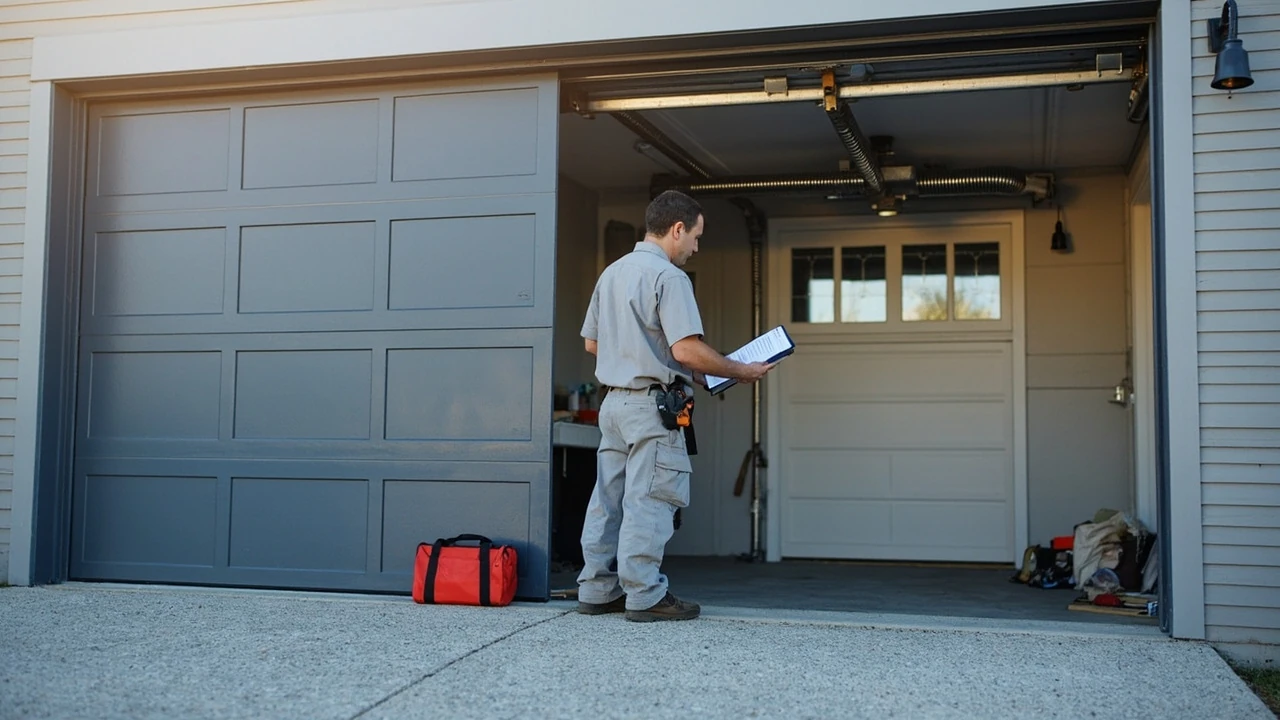
Garage door services can mean anything from replacing a remote to dealing with a door hanging crooked across the opening. Before booking, describe what the door is doing and whether anyone can safely approach it. A broken spring, loose cable or displaced door needs a trained door technician. Repeatedly pressing the opener will not make that mechanical problem go away.
For a routine appointment, the useful outcome is a written diagnosis, a clear repair scope and a door whose safety features have been checked. Here is how we would sort the work, compare a repair with replacement and read a quote without relying on a made-up national price list.
When to stop using the garage door
Keep people, pets and vehicles away if the door is crooked, a cable is loose or frayed, a spring appears broken, or a section has come out of its track. Do not try to straighten it, support it with household objects or move underneath it to investigate. If someone is trapped or injured, call emergency services.
Be especially careful with the emergency release. Disconnecting an open door with a failed counterbalance can allow it to fall. Chamberlain’s manual-operation guidance warns against releasing a door with damaged springs, cables or rollers and says to stop if it is unusually heavy or will not stay open. Its release instructions differ between opener types. This article does not replace the manual for your system.
A power outage by itself does not establish that the door is mechanically sound. If the door is stuck open or you suspect damage, ask a door professional how to secure the opening; do not pull the cord just to see what happens.
Which service do you actually need?
| What you notice | What to discuss when booking |
|---|---|
| The door is crooked, jammed or has an obvious broken component | A mechanical safety assessment. Explain that the door should not be operated before inspection. |
| The opener runs but the door does not move | Diagnosis of both the opener and door mechanism. A new motor should not be assumed to be the answer. |
| The door reverses or refuses to close | Entrapment-protection checks and a search for obstructions or mechanical faults. Do not bypass a sensor to finish closing it. |
| A remote or keypad has stopped responding | The model, affected controls and any displayed fault indication. Tell the company if the wall control behaves differently. |
| There is daylight, water or debris around the closed opening | Inspection of seals, fit and the surrounding opening. Weatherstripping cannot correct every water-entry problem. |
| You want a different appearance or insulation specification | A replacement or manufacturer-approved upgrade proposal, including the effect on the rest of the assembly. |
These are booking descriptions, not diagnoses. Similar symptoms can come from different faults. Tell the office if access to a vehicle is blocked, but do not accept a promise that a particular part will fix the problem before anyone has inspected it.
Springs, cables and brackets belong in the specialist’s scope
The counterbalance helps the door move without its full weight being carried by the opener. Springs and their connected hardware can remain under substantial tension when the door is stationary. A shut door is not permission to loosen a bottom bracket.
DASMA’s garage-door safety advice identifies spring work, worn lifting cables and bottom-bracket adjustments as work for trained door-system technicians. Extension-spring systems also need the appropriate containment cables. Have the existing arrangement assessed rather than using a photograph to decide what to fit.
We would leave roller replacement, track repositioning and hinge removal out of a general homeowner checklist too. The location of a component matters, and some hardware is connected to the loaded lifting system. A recommendation to clamp the door open and start removing pieces is not a sufficient safety procedure.
Before hiring a handyman, ask about specific door-system training and the exact proposed task. Experience painting trim or replacing a keypad does not establish competence to work on a counterbalance. A company serving commercial customers may also have suitable residential technicians; assess the actual experience rather than assuming the business name settles it.
Repair or replace: ask what is damaged
A failed opener does not automatically require a new door. A damaged section does not automatically mean a replacement panel is available either. Ask the company to identify the door and explain whether compatible parts can still be obtained.
For a repair proposal, we would want to know what failed, what else was inspected and which existing parts will remain. For a replacement proposal, we would ask for the complete installed specification. Comparing an inexpensive part-only figure with a new door, track, disposal and opener package tells you very little.
Age can inform that conversation, but there is no universal fifteenth-birthday replacement deadline. The condition of the sections and hardware, availability of parts, previous damage, intended use and the actual quotes all affect the choice. Nor is there a dependable rule that a repair above half the price of a new system must be rejected.
If only a section is being changed, ask how the repair affects weight and balance. For a complete replacement, confirm which track and hardware are approved for the new door. Existing track should not be reused merely because it appears to fit.
What should be written in the estimate?
Keep the proposal specific enough that you can compare it with another company’s offer. It need not include a page of unexplained spring dimensions, but it should identify the equipment and the work you are authorizing.
- Door or opener identification, the diagnosed fault and the proposed repair or replacement.
- Parts to be supplied, their specification where relevant, labor and any service-call charge.
- Whether the diagnostic fee is charged separately, credited toward work or subject to conditions.
- Disposal, delivery, electrical work, framing repairs and other inclusions or exclusions.
- What could change the price and how you must approve additional work.
- Parts and labor warranty terms, who handles a callback and how to contact that business.
A low figure may cover a smaller scope, but price alone does not prove that a contractor is honest or dishonest. Ask the same questions of every bidder. If a company recommends replacing several parts, request an explanation for each rather than accepting a package simply because it is described as a safety upgrade.
Check the business identity and any licensing requirements applicable to the work in your location. Request insurance information directly. Neither a search advertisement nor a branded vehicle verifies those details. Avoid signing a blank authorization or agreeing to work whose price and scope remain unclear.
Opener replacement needs more than a horsepower comparison
Give the installer the door’s dimensions, construction and model details if available. Ask whether the proposed opener is approved for that door and whether the available headroom, mounting arrangement and power supply suit it. A bigger motor is not a repair for a door that is out of balance.
Noise matters if a bedroom adjoins the garage, but a drive label by itself does not predict the noise in your house. Mounting, the door and the building also affect what you hear. Ask to compare the specific models’ instructions, features and warranty terms instead of accepting blanket claims that one drive type always lasts longest.
Entrapment protection deserves its own discussion. The U.S. Consumer Product Safety Commission’s safety alert recommends repairing or replacing openers that do not reverse properly. It also describes external protection, which may use photoelectric sensors, an edge sensor or an equivalent system. A claim that every compliant opener must use identical photo-eyes is too broad.
Ask the technician to demonstrate the applicable safety checks and show you the instructions for repeating the owner’s tests. Never use a person, a pet, a hand or a foot as a test obstruction. If a safety test fails, stop using the automatic system and arrange service; increasing force or bypassing protection is not a fix.
Insulation and seals: check the assembly before adding material
Replacing damaged seals may be a reasonable maintenance task, but first check the manufacturer’s instructions and how the seal is attached. Work involving loaded brackets or an unstable door belongs with the technician. Keep proposed threshold changes separate from a promise that all water problems will disappear.
Adding an insulation kit also changes the weight of the door. DASMA technical data sheet 176 explains that door components are designed to work together for the intended load. Get the original manufacturer’s approval for an addition and have its effect on balance and operation assessed. Do not compensate for extra weight by turning up the opener’s force.
For an attached, unconditioned garage, the boundary between the garage and the living space needs attention too. The Building America Solution Center’s guide addresses air sealing and insulation at shared walls and ceilings. An insulated vehicle door is not a substitute for dealing with gaps between the garage and the house.
When comparing replacement doors, ask what the quoted thermal figure measures and compare equivalent specifications. We cannot calculate an energy saving or resale return from a panel’s advertised R-value. Location, the whole building and how the garage is used would be needed for that assessment.
Maintenance without turning it into a repair project
Keep the door and opener manuals together. Use their inspection, cleaning and lubricant instructions: components have different requirements, and a universal instruction to spray every roller, spring and rail is poor advice. Observations from a safe position are useful; removing hardware to inspect it is a different job.
The CPSC alert recommends inspecting the door and opener every 30 days. That is an owner’s observation and safety-check recommendation, not a requirement for a paid monthly service visit. Arrange professional attention when the instructions call for it or when something changes in the door’s behavior.
Note new noise, uneven movement, visible cable wear or damage without repeatedly cycling a suspect door. If the system already looks unsafe, do not perform routine operating tests to confirm the fault. Send the company a description, and photographs only if you can take them without entering the danger area.
After a service visit, keep the invoice, part details, warranty and test information. Ask what you should monitor and when the next inspection is appropriate for that particular system. A generic one- or two-year interval cannot replace its instructions or account for a newly observed fault.
Questions worth settling before the technician leaves
Was the fault actually corrected?
Ask for an explanation of what was found, what was replaced and the checks completed afterward. If the door cannot yet be used, get clear instructions for keeping the area safe and the next appointment in writing. Do not assume that paying a diagnostic charge means a repair has been completed.
Do the opener and door both need replacing?
Sometimes a combined project is appropriate, but it is not automatic. Have the company explain compatibility and condition separately. An existing serviceable opener may be suitable for an approved new door; a new opener may be unsuitable for a damaged existing one.
Is a quoted spring life a guarantee?
Ask whether a number describes a specified cycle rating, a warranty term or a prediction for your household. Those are different things. An open-and-close cycle count cannot be converted into years without an assumed usage rate, and a rating is not a promise of an exact failure date.
Does a commercial or fire-rated door need the same visit?
Tell the company what kind of opening you have before booking. A fire-rated assembly, rolling door or warehouse entrance can require different competence and documentation. This homeowner guide does not specify commercial inspection intervals or fire-door tests.
For the rest of the house, our home-maintenance articles cover other repair decisions. Garage-door work should still be assessed on its own equipment and hazards. We have not inspected your door, tested the featured installation or priced a local repair.
Leave a Reply