


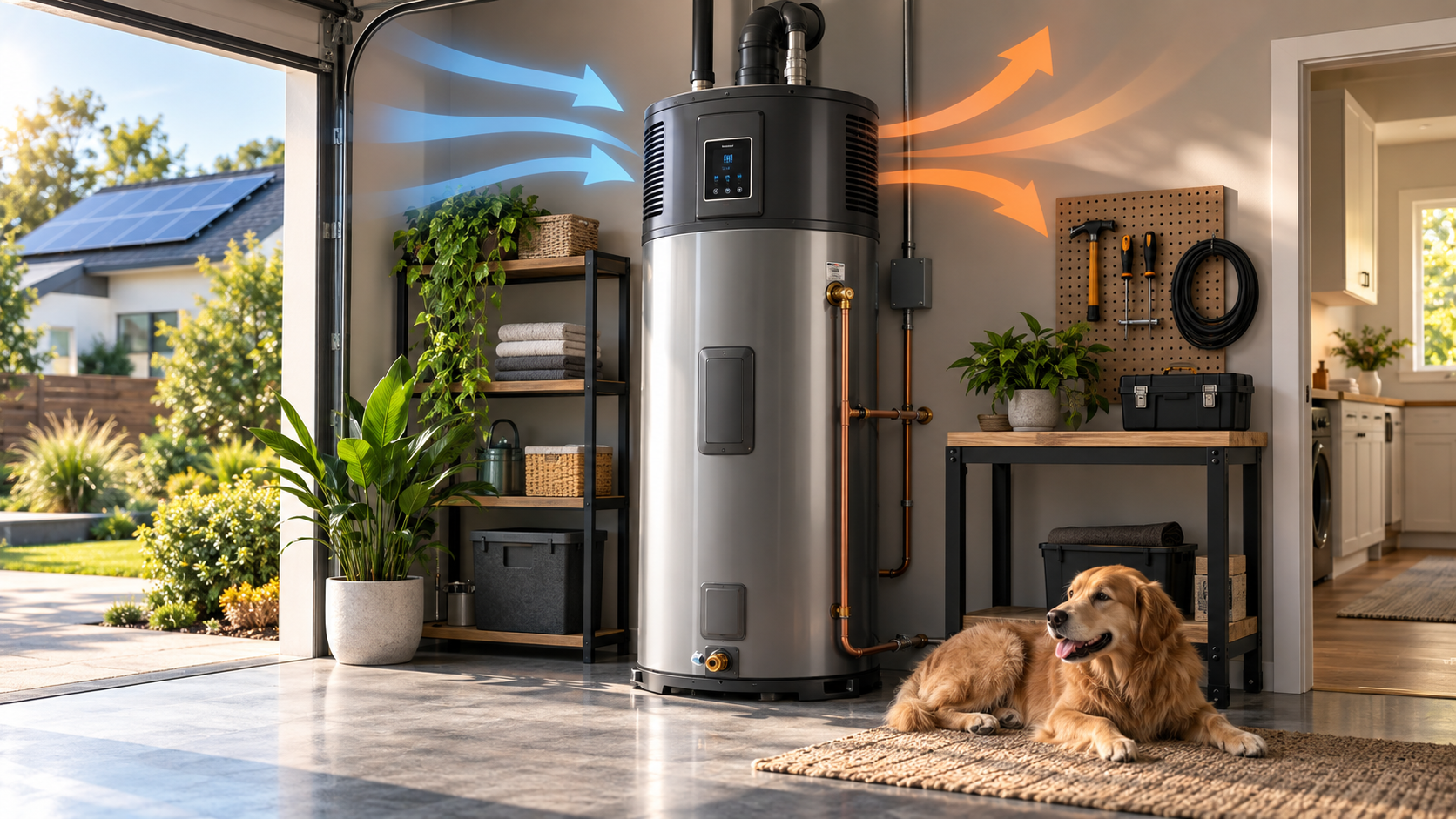
A water heater is one of those appliances most people happily ignore. It sits in the garage, basement, or utility room, quietly doing its job until one morning the shower turns cold.
Then suddenly, water heaters become very interesting.
If you are replacing an old electric tank in 2026, there is a good chance you will run into the term hybrid water heater. You may also see heat pump water heater, HPWH, hybrid electric water heater, or heat pump hybrid.
Most of the time, those names are describing the same basic idea: an electric storage water heater that relies mainly on heat pump technology but can also turn on traditional electric resistance heating when extra hot water is needed.
And that combination is why these appliances have become such an interesting option for U.S. homeowners.
An ENERGY STAR certified heat pump water heater can consume dramatically less electricity than a standard electric resistance tank. For a household of four, current ENERGY STAR estimates put average savings at roughly $550 per year compared with a conventional electric water heater.
That sounds great. But a hybrid water heater costs more upfront, needs the right installation space, produces some noise, creates condensate, and can cool the room around it.
So is it worth paying extra?
For many homes, yes. But not every home.
What Is a Hybrid Water Heater?
A hybrid water heater is basically a heat pump sitting on top of an insulated hot-water storage tank.
Instead of creating most of its heat with electric resistance elements, it takes warmth from the surrounding air and transfers that heat into the water.
Think about a refrigerator working backward.
Your refrigerator removes heat from inside the refrigerator and releases it into your kitchen. A heat pump water heater pulls heat from the room and moves it into the tank.
Moving heat takes far less electricity than generating the same amount of heat directly with resistance coils.
That is the efficiency advantage.
The word “hybrid” comes from what happens when the heat pump alone cannot keep up. Most models also contain conventional electric heating elements. During periods of heavy demand, the unit can combine heat-pump heating with resistance heating to recover hot water faster.
So you get efficiency most of the time without giving up the ability to handle a busy morning.
How Does a Hybrid Water Heater Work?
The process sounds technical, but the basic sequence is pretty simple.
- A fan pulls warm room air across an evaporator.
- Refrigerant absorbs heat from that air.
- A compressor raises the refrigerant temperature.
- The captured heat is transferred into the water tank.
- Cooler, drier air is released back into the room or directed through ducting on compatible models.
- Electric resistance elements can turn on when hot-water demand exceeds what the heat pump can comfortably provide.
That last part matters.
If four people take showers in quick succession while the dishwasher and washing machine are running, the appliance does not simply shrug and tell everyone to wait three hours.
In hybrid mode, it can bring in the electric elements and speed things up.
Hybrid Water Heater Operating Modes
Modern models usually let you decide how aggressively the appliance prioritizes efficiency versus recovery speed.
| Operating Mode | How It Works | Best For |
|---|---|---|
| Heat Pump / Efficiency | Primarily relies on the heat pump | Maximum energy savings and normal daily demand |
| Hybrid / Auto | Heat pump runs first, resistance heat assists when needed | Most households and changing hot-water demand |
| Electric / High Demand | Relies heavily or entirely on resistance heating | Temporary periods of unusually high hot-water demand |
| Vacation | Reduces normal heating while the home is vacant | Trips and extended time away |
Names vary by manufacturer, but the idea is similar.
For everyday operation, hybrid or heat-pump mode normally makes the most sense. Running electric-only mode all year rather defeats the reason you bought an efficient appliance in the first place.
How Efficient Is a Hybrid Water Heater?
This is where the technology gets interesting.
A traditional electric tank converts electrical energy directly into heat. It is straightforward, reliable, and relatively cheap to buy.
A heat pump water heater moves existing heat instead.
Current ENERGY STAR criteria require most integrated heat pump water heaters to reach a Uniform Energy Factor, or UEF, of at least 3.30. By comparison, a normal electric resistance tank generally operates with a UEF around 0.90 to 0.95.
You do not need to memorize those numbers.
The useful takeaway is simple: a good hybrid unit can provide several times more water-heating output per unit of electricity than a conventional electric tank because most of the energy is being moved rather than created.
ENERGY STAR estimates that certified heat pump water heaters can cut water-heating energy consumption by around 70% compared with standard electric resistance models.
How Much Can a Hybrid Water Heater Save?
Savings depend on household size, electricity prices, hot-water habits, tank temperature, climate, operating mode, and what type of water heater you are replacing.
The savings are usually easiest to justify when replacing a standard electric resistance tank.
ENERGY STAR currently estimates these approximate annual savings:
| Household Size | Approximate Annual Electricity Savings | Estimated Annual Dollar Savings | Estimated Lifetime Savings |
|---|---|---|---|
| 2 people | About 1,880 kWh | About $270 | About $2,050 |
| 3 people | About 2,820 kWh | About $410 | About $3,830 |
| 4 people | About 3,760 kWh | About $550 | About $5,610 |
These are estimates, not promises.
If electricity is expensive where you live, savings can be larger. If your utility rate is unusually low, payback can take longer.
If you are replacing propane or oil water heating, the operating-cost difference may also be attractive. Comparing a hybrid unit with an efficient natural-gas heater is more dependent on local gas and electricity prices.
How Much Does a Hybrid Water Heater Cost in 2026?
This is where enthusiasm usually cools down a little.
A hybrid water heater costs more upfront than a basic electric storage tank.
Current U.S. pricing commonly puts the unit itself around $1,200 to $3,500, depending on tank capacity, efficiency, brand, controls, and features.
A complete professionally installed heat pump water heater project frequently lands around $3,200 to $4,700. Current national project data puts an average installation near $4,200, although simple replacements can cost less and difficult conversions can climb toward $8,000.
Why the gap between the appliance price and the final bill?
Because the water heater does not install itself.
You may need plumbing changes, electrical work, a drain for condensate, new shutoff valves, a drain pan, seismic restraints in some regions, permits, or changes to the installation area.
If you are replacing an existing 240-volt electric tank, the job can be relatively straightforward.
Switching from gas is another story.
Replacing an Electric Water Heater Is Usually Easier
If your current water heater is a standard electric tank, you already have much of the infrastructure a typical 240-volt hybrid unit needs.
The existing plumbing can often be adapted. The electrical circuit may already be suitable. That can keep installation costs under control.
The installer still needs to deal with condensate drainage and make sure the room provides enough air for the heat pump.
But compared with a complete fuel conversion, it is often the easier scenario.
Replacing a Gas Water Heater Takes More Planning
Moving from gas to a hybrid electric water heater can make sense, especially for homeowners who are already electrifying other appliances.
But do not buy the tank first and figure out the electrical part afterward.
Many full-size hybrid units need a dedicated 240-volt circuit. If your old gas heater used only a standard outlet or no meaningful electrical supply at all, an electrician may need to run a new circuit.
In some homes, the electrical panel also needs additional capacity.
There are now 120-volt heat pump water heater options designed for certain retrofit situations, so a 240-volt upgrade is not universal. But 240-volt integrated models remain common.
Gas venting may also need to be capped correctly after the old appliance comes out.
All of this should be included when comparing quotes.
Where Can You Install a Hybrid Water Heater?
Location matters more with a heat pump water heater than with a basic electric tank.
The appliance needs air because air is where it gets much of its heat.
Current ENERGY STAR installation guidance says many models need around 700 cubic feet of surrounding air, roughly equivalent to a 10-by-10-foot room with a seven-foot ceiling. Some newer units can operate with around 450 cubic feet.
That makes garages, basements, large utility rooms, and mechanical rooms natural candidates.
A tiny sealed closet may not work unless the installation includes louvers, transfer grilles, or approved ducting.
The manufacturer’s specifications always win here.
Best Places for a Hybrid Water Heater
A good location usually has several things going for it:
- Enough surrounding air volume for the specific model
- A temperature range suitable for heat-pump operation
- A practical route for condensate drainage
- Access to the required electrical circuit
- Enough room above and around the unit for service
- Some tolerance for fan and compressor noise
- Easy access to the home’s existing hot- and cold-water plumbing
A garage can be particularly attractive in warmer regions. The heater gets plenty of air and can even provide a little cooling and dehumidification while it operates.
In a basement, that cooling and drying effect may also be welcome.
In a tiny laundry closet next to your bedroom?
Maybe not.
Yes, It Will Cool the Room
This surprises some first-time owners.
A hybrid water heater pulls heat out of surrounding air. Naturally, the air coming out of the unit is cooler.
In summer, that can feel like a tiny bonus.
In winter, particularly in a heated basement, the story is more nuanced. The appliance may be taking heat that your HVAC system paid to produce.
That does not automatically make the system inefficient overall, but placement becomes more important in very cold regions.
Garages, utility areas with waste heat, and spaces that do not need to stay cozy are often good candidates.
Some units allow intake or exhaust ducting, giving installers more flexibility.
What Happens in a Cold Garage?
Heat pumps become less effective as the surrounding air gets colder.
Manufacturers specify a compressor operating temperature range. Below the model’s lower temperature limit, the appliance may rely more heavily on its electric resistance elements.
That means a hybrid water heater installed in a warm Florida garage may spend more time in efficient heat-pump mode than the same model sitting in a freezing northern garage in January.
This is not a reason to avoid the technology in cold states.
It is a reason to pay attention to location.
A conditioned basement or properly designed mechanical room may be a much better winter location than an unheated detached space.
Hybrid Water Heater Sizes
Heat pump water heaters commonly come in 50-, 65-, and 80-gallon sizes.
Do not automatically replace a 50-gallon electric tank with a 50-gallon heat pump model without thinking about your household’s peak demand.
Heat pumps recover water more slowly than high-output electric resistance or gas heating.
Because of that, upsizing the tank can help the appliance remain in efficient heat-pump mode more often.
A household of four that regularly takes back-to-back showers may be happier with a 65- or 80-gallon hybrid tank than a smaller model that frequently calls on its resistance elements.
More stored hot water gives the heat pump time to do what it does best: heat slowly and efficiently.
First Hour Rating Matters More Than the Sticker Size
Tank capacity alone does not tell you how much hot water you will actually have during a busy hour.
Look at the First Hour Rating, often shortened to FHR.
That number estimates how much hot water a fully heated unit can supply during an hour of heavy demand.
Current ENERGY STAR requirements call for certified heat pump water heaters to provide a First Hour Rating of at least 45 gallons per hour.
If your household has several showers happening one after another every morning, compare FHR numbers between models rather than shopping only by tank gallons.
Will You Run Out of Hot Water?
You can. You can also run out of hot water with almost any storage tank.
The bigger issue is matching the unit to the household.
A properly sized hybrid water heater operating in normal hybrid mode should handle ordinary residential demand without drama.
Trouble often begins when a large household installs a small tank, sets it to heat-pump-only mode, and then expects it to recover like a high-output gas burner.
The technology is efficient, not magical.
If guests arrive for the weekend, temporarily switching to hybrid or high-demand mode can speed recovery.
Does a Hybrid Water Heater Make Noise?
Yes.
A regular electric resistance water heater is almost silent. A heat pump model has a fan and compressor, so you will hear it when it runs.
Think more along the lines of a modern refrigerator, dehumidifier, or quiet HVAC appliance rather than a washing machine on spin cycle.
Sound varies by model.
If the unit is going into a garage or basement, the noise may barely matter. If it is being installed near bedrooms, a home office, or a living room, look closely at the manufacturer’s sound rating.
Installation matters too. Vibration against walls or poorly supported plumbing can make a normal appliance seem much louder.
What Is That Drain Line For?
Heat pump operation removes moisture from the air, much like an air conditioner.
That moisture becomes condensate.
The water needs somewhere to go.
If there is a nearby floor drain, installation is usually easy. In other locations, the installer may need a condensate pump or another code-compliant drainage solution.
This sounds like a minor detail until the new water heater is sitting in your utility room and everyone realizes the nearest drain is 25 feet away.
Plan for it before installation day.
Pros of a Hybrid Water Heater
The biggest advantage is operating efficiency, but it is not the only one.
- Much lower electricity consumption than standard electric resistance water heating
- Potential annual savings of hundreds of dollars for larger households
- Heating and high-demand modes for different situations
- No combustion or flue required for normal electric heat-pump operation
- Can help cool and dehumidify garages, basements, and utility spaces
- Many newer models include Wi-Fi controls, schedules, vacation settings, and energy monitoring
- Large tank options can provide strong household hot-water capacity
- ENERGY STAR certified integrated models currently meet demanding efficiency standards
Cons of a Hybrid Water Heater
The trade-offs are pretty real too.
Upfront cost is higher. The equipment is usually taller than a conventional tank because the heat-pump assembly sits on top. You need airflow. You need condensate drainage. And there will be some fan noise.
Recovery can also be slower in maximum-efficiency mode.
In cold locations, heat-pump performance can drop and resistance heating may run more often.
Maintenance is slightly different as well. Many units have an air filter that needs periodic cleaning.
None of these issues is particularly alarming. They simply mean a hybrid tank should be planned rather than treated as a drop-in appliance in every situation.
How Long Does a Hybrid Water Heater Last?
A quality heat pump water heater can commonly serve a household for roughly 10 to 15 years, depending on water quality, installation, maintenance, usage, and the equipment itself.
ENERGY STAR currently bases some lifetime savings calculations on a 13-year service life.
The storage tank remains a major lifespan factor.
Minerals, corrosion, sediment, and water chemistry do not suddenly stop existing because there is a heat pump on top.
Follow the manufacturer’s maintenance instructions, particularly regarding the anode rod, filter, condensate drain, and tank flushing where recommended.
What Maintenance Does It Need?
The extra heat-pump components add a few small jobs.
The air filter should be inspected and cleaned according to the manufacturer’s schedule. A dirty filter reduces airflow and can hurt performance.
Keep air intake and exhaust areas free of boxes, laundry, dust, and other obstacles.
Check the condensate drain periodically so water can flow freely.
The tank itself needs the same basic attention you would give any storage water heater. Depending on local water conditions and manufacturer recommendations, that can include checking the anode rod and flushing sediment.
If you have very hard water, water quality can have a large effect on plumbing appliances in general.
Hybrid Water Heater vs. Standard Electric
If you are already heating water with a conventional electric resistance tank, the hybrid option is especially easy to understand.
The basic electric tank wins on purchase price and simplicity.
The hybrid wins on operating efficiency.
A standard electric heater may be the logical answer for a tiny household with very low hot-water demand and unusually cheap electricity.
But for a family running multiple showers, laundry loads, and a dishwasher every day, the energy difference can add up quickly.
That is why payback tends to improve as household hot-water consumption grows.
Hybrid Water Heater vs. Gas Water Heater
This comparison is less straightforward.
Gas water heaters usually recover hot water quickly and can be inexpensive to operate where natural gas rates are low.
Hybrid electric units avoid combustion, venting, and on-site gas burning, while providing very high energy efficiency.
The operating-cost winner depends on your utility rates.
Someone paying expensive electricity and cheap natural gas may get different math from someone with rooftop solar, high gas charges, or low electric rates.
Also factor in conversion cost. Replacing an existing gas tank with another gas tank may be inexpensive. Changing to a heat pump unit may require electrical work.
Hybrid Water Heater vs. Tankless
These two technologies solve the problem differently.
A tankless heater avoids storing large amounts of hot water and instead heats water as it flows through the unit.
A hybrid water heater stores hot water but heats it very efficiently.
Tankless can be attractive where space matters and continuous hot water is a priority. But high-output electric tankless units can require substantial electrical capacity, while gas tankless systems need proper gas supply and venting.
A hybrid tank takes more physical space but can offer very low operating costs, especially compared with traditional electric water heating.
Neither is automatically “better.”
The house decides.
What Happened to the Federal Tax Credit in 2026?
This is important because a lot of older articles still say homeowners can receive a federal tax credit of up to $2,000 for a qualifying heat pump water heater.
That information is now outdated for new installations in 2026.
The federal Energy Efficient Home Improvement Credit applied to qualifying heat pump water heaters placed in service through December 31, 2025. Current IRS guidance says the credit is not available for property placed in service after that date.
So if you install a hybrid water heater in 2026, do not automatically subtract $2,000 from your project budget based on an older article or contractor webpage.
State, utility, manufacturer, and local rebate programs may still exist. These vary widely by location and can change during the year.
Check the specific program before buying equipment.
Is a Hybrid Water Heater Good With Solar Panels?
It can be an excellent match.
If your home produces electricity from rooftop solar, moving water heating away from gas or high-consumption resistance heating can let more household energy needs run on electricity you partly produce yourself.
Some smart heat pump water heaters can also schedule heating around utility time-of-use rates.
For example, you may heat the tank more aggressively during low-cost periods and let the stored hot water carry you through expensive peak hours.
In that sense, a large hot-water tank becomes a simple thermal battery.
Should You Buy a 50-, 65-, or 80-Gallon Model?
Do not size only by the number of bedrooms.
Think about actual behavior.
Does everyone shower in the morning? Do you have a large soaking tub? Teenagers? Frequent guests? A high-flow shower? Multiple bathrooms?
A couple may be perfectly comfortable with 50 gallons.
A family of four could benefit from 65 gallons. A household with five people or high simultaneous demand may find an 80-gallon unit more comfortable.
Oversizing slightly can sometimes improve efficiency because a larger reserve reduces the need for resistance heat during peak demand.
But bigger tanks cost more and take up more space.
What Should You Ask an Installer?
Do not let the entire conversation be “How much?”
Ask what electrical circuit the unit needs. Ask whether the panel has capacity. Ask where condensate will drain. Ask whether the room meets airflow requirements.
Ask for the First Hour Rating and Uniform Energy Factor of the exact model.
Ask whether a larger tank would let your household stay in heat-pump mode more often.
And get the full installed price in writing, including electrical work, permits, old-unit removal, drain work, valves, expansion tank requirements where applicable, and any changes to the plumbing.
The cheapest tank does not always create the cheapest project.
Who Probably Should Buy a Hybrid Water Heater?
A hybrid water heater deserves a serious look if you currently have a standard electric tank, your household consumes a fair amount of hot water, and you have a garage, basement, or utility space with adequate air volume.
It also makes sense for homeowners who plan to stay in the property long enough to benefit from lower operating costs.
If your old electric tank is already 10 or 12 years old, researching the replacement now is much nicer than researching it while standing in a puddle.
Who Might Be Better Off With Something Else?
A hybrid tank may be awkward if the only available location is a tiny sealed closet, the installation area gets extremely cold, electrical upgrades are unusually expensive, or noise near living areas would bother you.
A small household with minimal hot-water demand may also take longer to recover the higher purchase price through energy savings.
And if cheap natural gas is already serving a modern efficient water heater, the economics may not be as dramatic as replacing electric resistance heat.
This is not a universal upgrade.
It is a very efficient tool that works best in the right house.
FAQ
What is a hybrid water heater?
A hybrid water heater is an electric storage water heater that primarily transfers heat from surrounding air into the tank through a heat pump. Most models also contain electric resistance elements that can provide faster heating during periods of high demand.
How much does a hybrid water heater cost in 2026?
The equipment commonly costs about $1,200 to $3,500. A complete professional heat pump water heater installation often falls around $3,200 to $4,700, although electrical upgrades, plumbing changes, permits, and difficult access can push the project higher.
How much electricity does a hybrid water heater save?
ENERGY STAR certified heat pump water heaters can consume around 70% less energy than conventional electric resistance models. ENERGY STAR currently estimates savings of about $550 per year for a typical household of four, though actual savings depend on rates and usage.
Does a hybrid water heater work in winter?
Yes, but heat-pump performance depends on the temperature around the appliance. In a very cold installation area, the unit may rely more heavily on resistance heating. A conditioned basement or suitable indoor mechanical room can work better than a freezing garage in a cold climate.
Does a hybrid water heater need a drain?
Yes, heat-pump operation creates condensate. The water needs to flow to an approved drain or condensate pump. The exact arrangement depends on the installation location and local plumbing requirements.
Is there a federal tax credit for a hybrid water heater in 2026?
No federal Energy Efficient Home Improvement Credit is available for a heat pump water heater placed in service after December 31, 2025 under current IRS guidance. State, local, or utility incentives may still be available.
Is a hybrid water heater worth the extra cost?
It often is when replacing a conventional electric water heater, particularly for a household with moderate or high hot-water demand. The higher purchase price can be offset by lower electricity bills over the life of the appliance. Installation conditions and local energy prices still matter.
Conclusion
A hybrid water heater is not just a fancy electric tank.
Most of the time, it heats water by moving warmth that already exists in the surrounding air. When the household suddenly needs more hot water, resistance elements can step in and increase recovery speed.
That combination solves one of the big problems with highly efficient appliances: nobody wants efficiency if it means a cold shower at 7:15 on Monday morning.
The technology is especially compelling for homeowners replacing conventional electric water heaters. ENERGY STAR estimates that a family of four can save roughly $550 per year compared with a standard electric model.
But the purchase decision should go beyond the utility bill.
Look at the room.
Is there enough air? Where will the condensate drain? Is the water heater close to bedrooms? Does the space stay reasonably warm during winter? Is there already a suitable 240-volt circuit? How much hot water does your household actually consume during its busiest hour?
Then look at size.
A larger 65- or 80-gallon tank may cost more, yet it can help a busy household stay in efficient heat-pump operation rather than constantly calling on resistance heating.
And finally, look at the whole installation price rather than the sticker on the appliance.
A $1,600 unit that requires major electrical work may cost more to install than a $2,000 unit going into a house that is already prepared for it.
For the right home, a hybrid water heater is one of those upgrades that becomes less interesting after installation – in a good way.
You stop thinking about the technology.
You turn on the shower, hot water comes out, and the electricity bill quietly gets smaller.
Leave a Reply