


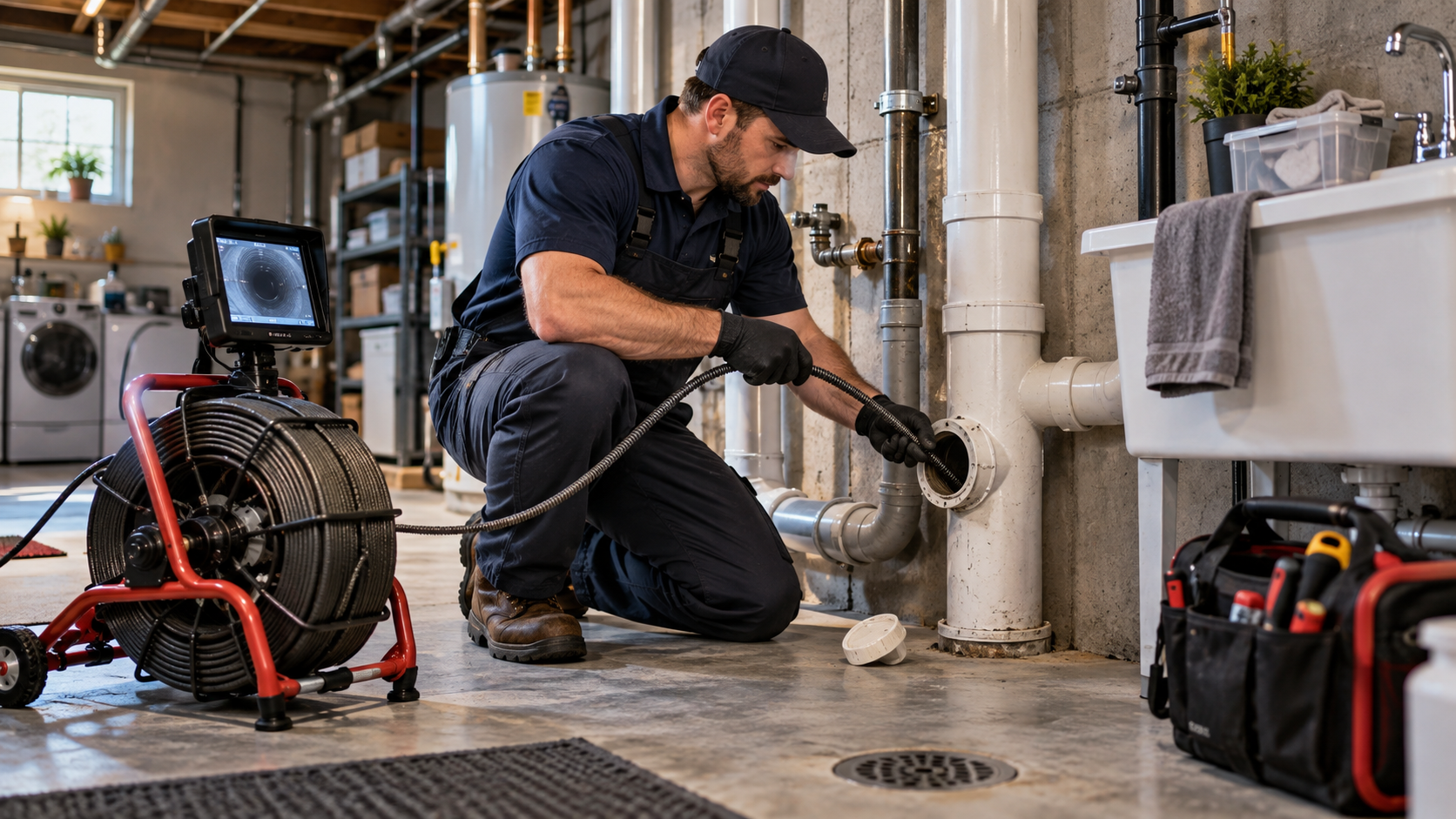
A slow bathroom sink is annoying. Three slow drains at the same time are a different story.
If the toilet gurgles when the washing machine drains, water appears in the bathtub after someone flushes, or sewage starts coming up through a basement floor drain, the problem may not be one fixture at all. It may be the main drain line serving the house.
That is where main drain cleaning comes in.
The main drain carries wastewater from toilets, sinks, showers, tubs, laundry equipment, and other plumbing fixtures toward the municipal sewer or, in some homes, a septic system. When that pipe becomes blocked, everything upstream can begin acting strangely.
And yes, this is one plumbing problem you generally want to address sooner rather than later.
A partly blocked sewer line can turn into a full backup surprisingly fast when several fixtures are used at once. Once sewage reaches floors, drywall, furniture, or stored belongings, a drain-cleaning bill can become a cleanup and restoration bill too.
In 2026, professional main sewer line cleaning commonly costs about $200 to $500 for a straightforward clog cleared with a snake or auger. More severe blockages treated with hydro jetting often run about $600 to $1,400. The actual price depends on the cause, access, pipe condition, location, and whether additional inspection or repair is needed.
So before pouring anything mysterious down the drain, it helps to understand what is actually happening.
What Is the Main Drain Line?
Every drain in your house eventually joins a larger pipe.
Your kitchen sink has a branch drain. So does the shower, toilet, washing machine, and bathroom sink. Those smaller lines connect to larger building drains, which eventually carry wastewater out of the home.
For homes connected to a public sewer system, the private sewer lateral generally runs from the house toward the municipal sewer. Exactly where homeowner responsibility ends depends on the local utility and jurisdiction.
When homeowners talk about a “main drain clog” or “main sewer clog,” they are usually talking about a blockage somewhere in this larger line rather than a clog limited to one sink or shower.
That distinction matters.
If only the kitchen sink drains slowly while every toilet and shower works normally, the clog is probably local. If several fixtures begin misbehaving together, the main line deserves attention.
Signs You May Need Main Drain Cleaning
A main line problem rarely introduces itself politely.
The first warning can be subtle: a toilet that suddenly bubbles, a shower that drains slower than usual, or a strange gurgling sound from a fixture that was working fine yesterday.
Then another drain starts doing the same thing.
Common warning signs include:
- Several sinks, toilets, tubs, or showers draining slowly at the same time
- Water backing up into a bathtub or shower when a toilet is flushed
- A toilet bubbling when the washing machine or sink drains
- Gurgling sounds coming from multiple plumbing fixtures
- Sewage odors from drains or around a sewer cleanout
- Wastewater appearing around a basement or lower-level floor drain
- Repeated clogs that return soon after individual drains are cleared
- Water or sewage backing up through the lowest fixture in the house
- Unusually wet or foul-smelling areas outside near the sewer line
The lowest fixtures often show trouble first because wastewater follows gravity. In a house with a basement, that may mean a floor drain, utility sink, shower, or toilet downstairs.
If actual sewage is backing into the home, stop using water whenever practical until the problem is assessed. Running the dishwasher, taking a shower, and doing laundry simply adds more water behind the blockage.
Why Main Sewer Lines Get Clogged
A main sewer line is larger than the pipe beneath your bathroom sink, so it normally takes more than a little hair or soap residue to shut it down.
Several problems are far more common.
Grease and Fat Buildup
Cooking grease looks harmless when it is hot and liquid.
Once it cools inside plumbing, that changes.
Fats, oils, and grease can stick to pipe walls and collect other debris as it passes. Over time, the opening becomes smaller until wastewater struggles to get through.
Running hot water behind grease does not make it disappear. It simply moves the grease farther into the plumbing before it cools.
Wipes and Other Items That Should Not Be Flushed
Toilets are designed to handle human waste and toilet paper.
Many household products do not break apart nearly as easily. Wipes are a notorious example, including some products marketed as flushable.
Paper towels, diapers, feminine hygiene products, dental floss, and similar materials can catch on rough sections of pipe and help build a larger blockage.
It usually starts small. Then one object catches another, and another. Plumbing has its own version of a snowball.
Tree Roots
Roots do not normally smash straight through a perfectly intact sewer pipe in search of your bathroom.
But if an older pipe has a loose joint, crack, or other opening, nearby roots can grow toward the moisture and nutrients inside it.
Once roots enter, they can form a dense mass that catches paper and waste.
Mechanical root cutting or hydro jetting can remove the obstruction, but cleaning does not repair the opening that allowed the roots inside. If they keep returning, a camera inspection may reveal a pipe defect that needs repair.
Old or Damaged Sewer Pipes
Sometimes the “clog” is not really a cleaning problem.
Older sewer lines can crack, separate, corrode, deform, or develop low sections commonly called bellies. Waste and paper can repeatedly collect in those areas.
A snake may reopen the line temporarily, but if the pipe itself has failed, the symptoms usually return.
This is why recurring main drain cleaning without a diagnosis can become expensive. You may keep treating the blockage while leaving the cause untouched.
Main Drain Cleaning Cost in 2026
National pricing varies quite a bit because one main-line clog may take 30 minutes to clear while another requires hours of work, video inspection, root cutting, and hydro jetting.
Here is a useful planning range for common services in the United States.
| Service | Typical 2026 Cost | What It Usually Covers |
|---|---|---|
| Main sewer line snaking | $200-$500 | Mechanical clearing of a minor to moderate blockage |
| Hydro jetting | $600-$1,400 | High-pressure cleaning for heavy buildup or stubborn clogs |
| General professional drain cleaning | About $147-$352 | Average range across many household drain-cleaning jobs |
| Main sewer clog repair average | About $380 | Typical professional main-line clog service |
| Video sewer inspection | Often $125-$500+ | Camera inspection to locate damage or blockage |
| Tree root removal | Often adds $200-$600+ | Cutting or clearing roots from the sewer line |
These are national ranges, not quotes.
Plumbing prices in San Francisco, Boston, New York, or Seattle can look very different from prices in smaller cities or rural areas. Emergency service at midnight on a holiday weekend also tends to cost more than a scheduled weekday appointment.
What Changes the Price?
The clog itself is only part of the calculation.
A plumber also has to consider where the blockage is, how the pipe can be accessed, what equipment is needed, and whether the line is safe to clean aggressively.
The main factors are usually:
- Clog location and distance from the access point
- Whether the blockage is grease, roots, waste, scale, or another material
- Whether the home has an accessible sewer cleanout
- Pipe age and condition
- Length and number of bends in the sewer line
- Whether a camera inspection is needed
- Whether hydro jetting or root-cutting equipment is required
- Local labor rates
- Emergency, weekend, evening, or holiday service
- Any cleanup or pipe repairs needed after the blockage is cleared
A cleanout can make a particularly large difference.
This is a capped pipe connected directly to the sewer line, often located outside near the house, in a basement, garage, crawl space, or near the property line.
It gives a plumber direct access for a snake, jetter, or camera.
Without one, access may require removing a toilet or approaching the sewer through another plumbing opening. That can add time and labor.
Snaking vs. Hydro Jetting
These are the two main methods homeowners hear about, and they do different jobs.
Drain Snaking
A sewer snake, cable machine, or power auger sends a flexible metal cable through the pipe.
The cable may have a cutting head or another attachment designed to break through the obstruction.
For an ordinary main-line clog, this can work very well.
Snaking is generally less expensive than hydro jetting and is often the first choice when the goal is simply to reopen a blocked pipe.
But a snake does not necessarily scrub the entire inside surface clean.
Imagine pushing a tunnel through a thick layer of buildup. Water flows again, but some material may remain along the pipe walls.
Hydro Jetting
Hydro jetting uses a specialized hose and nozzle to send high-pressure water through the sewer line.
Instead of merely punching through a blockage, the water can remove grease, sludge, scale, roots, and debris from the interior surface of the pipe.
Residential hydro jetting commonly costs around $600 to $1,400 in 2026.
It is often used when a line has heavy buildup, repeated grease problems, or stubborn obstructions that keep returning after conventional snaking.
But higher pressure is not automatically better.
An older, cracked, deteriorated, or fragile pipe may need to be inspected before aggressive jetting. A professional should consider pipe material and condition before selecting pressure and equipment.
Which Cleaning Method Makes More Sense?
| Situation | Likely Approach |
|---|---|
| One recent main-line clog | Snaking may be enough |
| Heavy grease buildup | Hydro jetting may clean more thoroughly |
| Repeated blockages | Camera inspection plus cleaning |
| Known tree roots | Root-cutting equipment, jetting, and inspection |
| Very old or fragile pipe | Inspection before aggressive cleaning |
| Suspected collapse or major structural problem | Camera inspection and repair rather than repeated cleaning |
A reputable plumber should be able to explain why a particular method is being recommended.
If the answer is simply “the more expensive machine is better,” ask another question.
When Is a Sewer Camera Inspection Worth It?
Not every straightforward clog needs a camera immediately.
If a plumber clears a one-time blockage and everything begins working normally, there may be little reason to turn the job into a full investigation.
Repeated problems are different.
A camera can help identify root intrusion, separated joints, cracks, corrosion, pipe bellies, foreign objects, and other conditions that cannot be diagnosed accurately from the kitchen floor.
It can also show whether cleaning actually removed the obstruction.
For an older home, especially one with a history of sewer trouble, that information can be far more valuable than another temporary clearing.
Main Drain Cleaning Is Not the Same as Sewer Repair
This distinction can save a lot of confusion.
Cleaning removes material from the pipe.
Repair fixes the pipe.
If a sewer has grease buildup, cleaning may solve the problem completely. If roots have entered through a cracked joint, cleaning removes the roots but does not seal the joint.
If a pipe has collapsed, no amount of snaking will restore the missing structure.
That is why a homeowner who needs main drain cleaning twice a year should probably stop thinking only about the clogs.
The question becomes: why do they keep happening?
Can You Clear the Main Drain Yourself?
Small household drain clogs are often reasonable DIY jobs.
A main sewer blockage is different.
Rental sewer machines are powerful. The cable can twist, bind, or kick back. Improper operation can damage plumbing or injure the person using the machine.
And if raw sewage is already present, there is a sanitation issue on top of the mechanical one.
DIY attempts also become risky when the homeowner does not know what caused the blockage. A cable may pass through the clog while missing a broken pipe, heavy roots, or a structural problem.
There is also the temptation to pour large amounts of chemical drain cleaner into the system.
That is rarely a good answer for a serious main sewer clog.
EPA guidance for septic systems specifically advises against chemical drain openers and warns against sending grease, wipes, paper towels, and other unsuitable materials into the system. Even in a home connected to municipal sewer, a main-line blockage is usually better diagnosed mechanically than attacked with repeated bottles of chemical cleaner.
What to Do If Sewage Is Backing Up
A sewer backup is not just unpleasant water on the floor.
Untreated wastewater can contain harmful microorganisms.
If sewage begins entering the home:
- Stop using toilets, sinks, showers, dishwashers, and washing machines when practical
- Keep children and pets away from the affected area
- Avoid direct skin contact with sewage
- Do not use electrical equipment while standing in contaminated water
- Call a plumber or sewer professional promptly
- Contact appropriate cleanup professionals if the contamination is extensive
- Photograph damage before cleanup if an insurance claim may be involved
- Check your homeowners insurance and any sewer-backup endorsement for applicable coverage
Do not assume ordinary mopping is enough after a significant sewage backup. Contaminated porous materials may require more extensive cleaning or disposal.
If the problem involves a septic system, EPA guidance recommends avoiding contact with backed-up sewage and contacting the appropriate local health or regulatory authority when needed.
Why the Lowest Fixture Often Backs Up First
This is basic plumbing physics, but it is useful for diagnosing a main-line problem.
Wastewater travels downhill through the drainage system.
If the main line becomes blocked, incoming water has nowhere to go. The level in the pipe rises until it reaches an opening.
The lowest available drain may become that opening.
That is why someone can flush an upstairs toilet and then discover water coming up through a basement shower.
It looks like the shower caused the problem.
It didn’t. The shower simply happened to be the lowest escape route.
What About Gurgling Toilets?
One isolated toilet gurgle is not proof of a blocked sewer.
But repeated bubbling accompanied by slow drains elsewhere deserves attention.
Drainage systems depend on both wastewater flow and air movement through plumbing vents. When flow through the main line becomes restricted, air can be displaced through nearby traps and toilets.
That bubbling sound is sometimes the plumbing system telling you it is struggling to breathe.
Tree Roots and Older American Homes
Mature neighborhoods come with beautiful trees.
They also often come with older sewer laterals.
Clay, cast iron, Orangeburg, and other older piping materials are still present in many U.S. properties. Condition varies enormously. Some old pipes continue working for decades. Others develop cracks, corrosion, joint separation, or deformation.
If roots are found once, removing them may solve the immediate problem.
If they are found repeatedly in the same location, ask for the camera footage.
You want to know what the roots are entering through.
Repeatedly cutting them back without addressing a major defect can turn plumbing maintenance into an annual subscription nobody wanted.
How Often Should the Main Sewer Line Be Cleaned?
There is no single cleaning schedule that every American home needs.
A newer PVC sewer line with no history of trouble may not need routine mechanical cleaning at all.
An older property with mature trees, recurring roots, grease buildup, or previous backups may benefit from periodic inspection or preventive cleaning.
Some sewer-cleaning professionals recommend intervals around 18 to 24 months for higher-risk properties, but that is not a universal rule.
Your actual history matters more than the calendar.
If the line has never clogged in 20 years, there is little reason to clean it every spring simply because someone put a reminder on a website.
If it clogs every November, there is probably a reason worth investigating.
How to Reduce the Chance of Another Main Drain Clog
Prevention is mostly boring, which is exactly what you want from plumbing.
Do not pour grease or cooking oil down the kitchen drain. Wipe greasy pans before washing them. Flush only human waste and toilet paper. Keep wipes, paper towels, hygiene products, diapers, dental floss, and similar items out of the toilet.
If you have recurring root intrusion, inspection and repair may ultimately make more sense than repeated emergency cleaning.
And pay attention when several drains begin slowing together.
Waiting until wastewater reaches the basement is rarely the cheaper strategy.
City Sewer or Septic System?
Not every house sends wastewater to a municipal sewer.
If your home has a septic system, a backup can involve the household plumbing, septic tank, outlet, distribution system, or drainfield.
EPA guidance recommends pumping a typical septic tank every three to five years, although actual frequency depends on household size, water use, tank size, and solids accumulation.
A septic tank that is overdue for service can sometimes produce symptoms that look like a clogged building drain.
Tell the plumber or septic professional what type of system you have before work begins.
The diagnosis and maintenance are not the same.
Do “Flushable” Wipes Cause Main-Line Problems?
This subject has caused more than a few arguments in American bathrooms.
A package may say flushable. Wastewater professionals are generally less enthusiastic.
EPA material identifies wipes and other household products as contributors to sewer problems and advises septic-system owners not to flush non-flushable wipes.
Toilet paper is designed to break apart quickly in water. Many wipes remain intact much longer.
For a homeowner who wants the least complicated plumbing life possible, the rule is wonderfully simple: toilet paper goes in the toilet; wipes go in the trash.
Does Homeowners Insurance Pay for Main Drain Cleaning?
Routine drain cleaning and ordinary maintenance are generally homeowner expenses.
Insurance becomes more relevant when a covered event causes damage or when wastewater backs into the home.
Many standard homeowners policies do not automatically provide broad sewer-backup coverage, and optional endorsements are common.
Policies differ, so do not assume coverage based on what happened to a neighbor.
Read your policy or ask the insurer specifically about water or sewer backup coverage.
How Long Does Main Drain Cleaning Take?
A straightforward snaking job may take somewhere around 30 minutes to two hours.
Hydro jetting or more involved work can take several hours.
Time increases when the clog is far from the cleanout, roots are heavy, multiple passes are required, access is difficult, or the plumber needs to inspect the pipe before and after cleaning.
Sometimes the cleaning itself is quick and diagnosis takes longer.
That is not necessarily a bad thing.
A technician who spends time figuring out why the line clogged may save you another service call three months from now.
What to Ask a Main Drain Cleaning Company
Price matters, but it should not be the only question.
Ask what the quoted price includes. Ask whether the company charges a service-call fee. Ask whether camera inspection is included or separate.
Find out whether the recommendation is snaking, hydro jetting, root cutting, or another method – and why.
If the line has a history of trouble, ask whether you can see the camera footage.
You may also want to know whether the company is licensed and insured where required, whether emergency rates differ, and what happens if the blockage turns out to be a broken sewer line rather than ordinary buildup.
A clear estimate is much more useful than a cheap number followed by five surprises.
FAQ
How much does main drain cleaning cost in 2026?
A straightforward main sewer cleaning commonly costs around $200 to $500. Hydro jetting for more severe buildup often costs roughly $600 to $1,400. Access, location, pipe condition, roots, emergency service, and camera inspection can increase the total.
How do I know if my main drain is clogged?
Common signs include several slow drains at once, toilets that gurgle when other fixtures drain, water backing into tubs or showers, sewage odors, and wastewater appearing from a basement or lower-level drain.
Is hydro jetting better than snaking?
Not automatically. Snaking can clear an ordinary blockage quickly and at lower cost. Hydro jetting cleans more of the pipe wall and can be useful for grease, sludge, roots, and recurring buildup. Pipe condition should be considered before high-pressure cleaning.
Can I use drain cleaner in a clogged main sewer line?
Chemical drain products are usually not a good substitute for diagnosing a serious main-line blockage. A large obstruction, roots, or damaged sewer pipe generally requires mechanical cleaning, inspection, or repair rather than repeated chemical treatment.
Will tree roots grow back after main drain cleaning?
They can. Removing roots clears the obstruction but does not repair the crack, joint, or opening that allowed the roots to enter. Repeated root problems are a good reason to inspect the pipe with a sewer camera.
How often should I have my main sewer line cleaned?
There is no universal schedule. A trouble-free modern line may not need routine cleaning. Older lines, properties with mature trees, or homes with repeated backups may benefit from periodic inspection or preventive cleaning based on their history.
When should I call a plumber immediately?
Call promptly if sewage is entering the home, multiple drains stop working together, toilets overflow because of a suspected main blockage, or wastewater appears through a basement floor drain. Limit water use until the blockage is assessed.
Conclusion
Main drain cleaning is one of those home maintenance jobs most people never think about until the plumbing suddenly refuses to cooperate.
And the biggest clue is usually not one slow drain.
It is several.
When the toilet bubbles as the washer drains, water rises in the shower after someone flushes, or the lowest drain in the house begins backing up, start thinking beyond the individual fixture.
For an ordinary blockage, professional snaking may be all that is needed. In 2026, that type of main-line service commonly costs around $200 to $500.
For heavy grease, years of buildup, roots, or a stubborn recurring clog, hydro jetting may provide a more thorough cleaning, typically at a higher cost of around $600 to $1,400.
But there is a bigger lesson here.
A clog that returns over and over is information.
Maybe roots are entering through a damaged joint. Maybe an old pipe has sagged. Maybe grease keeps accumulating. Maybe the sewer lateral itself is deteriorating.
That is when a camera inspection can be more useful than another round with the snake.
And prevention is wonderfully uncomplicated. Keep grease out of the sink. Do not treat the toilet like a trash can. Take early warning signs seriously. Know where your sewer cleanout is. If your property has a history of root problems or old piping, plan maintenance before you are dealing with sewage on the floor.
A main sewer line does its best work when nobody notices it.
Wastewater leaves. Drains stay quiet. Toilets flush. Life goes on.
That is a pretty good reason to deal with a warning gurgle before it becomes something much louder.
Leave a Reply