
Before you put water or cleaner on an oriental rug, check the care label and look for an invoice, maker’s information or an earlier cleaning record. A familiar pattern does not tell you what the pile, foundation or backing is made from. That matters when a rug contains wool, silk, viscose, old repairs or more than one material.
For a valuable or inherited piece with an uncertain history, arrange an assessment before a wash. At home, concentrate on gentle routine care and containing fresh spills. Keep a record of what has happened to the rug so the person treating it does not have to start with guesses.
Start with the label and the condition
The Carpet and Rug Institute’s basic rug-care advice directs owners of Oriental, Turkish and Persian rugs to the manufacturer’s specifications or a professional cleaning service. It specifically recommends professional help for heirloom rugs. A method advertised for ordinary wall-to-wall carpet should not be assumed suitable for a separate rug.
Photograph the front, back, fringe and any damaged areas before booking work. Save a clear picture of the label. Note previous spills, treatments, repairs and any color transfer you have already seen. If you do not know the fiber or age, say so; a guess written on an intake form is less useful than an honest gap.
| What you know | What to clarify |
|---|---|
| The label names wool or a blend | Whether the proposed products and process suit every listed material |
| The label names silk, viscose or a silk-like fiber | Which fiber it actually is; similar marketing descriptions do not make materials interchangeable |
| There is no label | How the cleaner will assess the construction and decide what treatment is appropriate |
| There are loose threads, repairs or worn fringe | How these areas will be protected and whether any repair is a separate job |
| A stain has already been treated | Which product was used, where and when |
What to do with a fresh spill
Place a clean, absorbent white cloth over the spill and blot gently. Change to a dry section as it absorbs liquid. Avoid rubbing the area. The Canadian Conservation Institute recommends absorbing liquid promptly rather than pressing a stain farther into the rug.
Once you have contained the spill, check the rug’s care instructions before adding a product. Write down what spilled and when it happened. If the rug is valuable, fragile or unidentified, ask a specialist for the next step. A photograph of the affected area and the label can help that conversation.
Nourison’s care guide stresses that the right method varies with the material and texture, and does not guarantee stain removal. Its guidance for viscose and silk-like regenerated fibers warns that moisture and rubbing can weaken or damage the pile. Advice for one fiber should not become a universal stain recipe.
| Situation | What to report | What not to assume |
|---|---|---|
| Wine, coffee or another colored drink | The drink, approximate area and any product already applied | That a household stain chart guarantees removal from this rug |
| Pet urine or a recurring odor | Where it happened and whether the rug, pad or floor has been treated | That an all-purpose enzyme cleaner is suitable for every fiber |
| Ink, wax or an unknown mark | A close photograph and the likely source, if known | That alcohol, an iron or a solvent is an appropriate first experiment |
| Color appearing on a cloth | Where the transfer occurred and whether the cloth was wet or dry | That more rubbing will solve it |
Gentle vacuuming between professional visits
For a sound rug that can tolerate vacuuming, use low suction, avoid a powered brush head and work slowly with the direction of the pile. Keep loose threads and fringe away from moving parts. For particularly fragile textiles, the Canadian Conservation Institute describes using a protective screen. Ask a conservator to show you an appropriate method if the rug is already damaged.
Use the rug’s condition and care instructions to guide the routine. If you notice a snag or a loose area, stop working over it rather than repeatedly passing the vacuum across it. Point out the affected section when you arrange an assessment.
The Carpet and Rug Institute also calls for gentle suction around fringe. Lift the edge carefully to clean underneath without feeding the fringe into the brush roller. General carpet-vacuuming advice is not permission to use full power on a fragile rug.
What a professional cleaning proposal should explain
Ask the cleaner to describe the treatment proposed for your particular rug. A useful answer connects the method to its materials, condition and previous treatments. “We wash every rug the same way” leaves the important questions unanswered.
- How will the rug and any unstable colors be assessed before treatment?
- Which areas are already worn, stained or repaired, and how will that condition be recorded?
- What cleaning method is proposed, and why is it suitable here?
- How will moisture be removed and drying checked before the rug is returned?
- Which marks may remain, and what requires separate treatment or repair?
- Who handles pickup, transport and storage while the rug is away?
Do not require an immersion bath simply because a guide calls it the traditional method. Equally, do not accept a portable extraction machine as proof that every rug can be treated in place. The decision needs to follow the assessment. For a historically important textile, ask about textile-conservation expertise rather than relying only on general carpet-cleaning experience.
Ask for written confirmation of the scope, expected turnaround and how damage concerns are handled. If insurance coverage matters to your decision, request the relevant details instead of inferring coverage from a badge on a website. Keep that confirmation with the intake photographs and receipt.
Understand the quote before authorizing work
Check whether the quote is a fixed total, a rate per square foot or an initial inspection estimate. For example, a rectangular 6-by-9-foot rug has an area of 54 square feet. That is an area calculation, not a current market price. Confirm how the provider measures the rug and whether the quoted dimensions include fringe.
Ask whether collection, delivery, stain work, odor treatment, repairs and taxes are included. Get approval arrangements for additional work in writing. A low advertised cleaning rate does not tell you the final amount when the scope is still undefined.
Ask when another assessment would be useful for the rug’s condition and use. An old but intact rug and a similarly sized rug with loose repairs may need different handling, even if the advertised cleaning rate is the same.
What cleaning can reasonably promise
A stain may remain after treatment. Nourison explicitly notes that stain outcomes depend on several conditions, so a promise to remove every mark deserves scrutiny. Ask the cleaner to distinguish removable soil from worn pile, faded color, a previous repair or damage that requires a different service.
Compare the returned rug with the intake photographs, especially around fringe, old repairs and the original stain. If something concerns you, document it and contact the provider before trying another chemical. Ask for an explanation and the proposed next step; a visible mark alone does not identify its cause.
Be equally cautious about diagnosing a white residue or brown patch from a photograph. The appearance may prompt an inspection, but it does not prove that a particular chemical, water source or drying mistake was responsible.
Placement, handling and storage
Limit direct sunlight, rotate the rug periodically and avoid dragging furniture across it. For storage, the Canadian Conservation Institute recommends a clean, dry rug with proper rolled support rather than folding it; its guide gives a detailed method using a wide tube and protective material. Ask for help with a large or fragile piece.
Do not treat cedar blocks or a scented product as proof that a stored rug is protected from pests. If you find suspicious damage, photograph it and seek an assessment. Avoid adding a cleaner or pesticide to an unidentified textile merely to make the smell disappear.
Can a small rug go in a washing machine?
Only an explicit care instruction can support that choice. The Carpet and Rug Institute discusses machine washing for rugs labeled machine washable; it is not a blanket recommendation for hand-knotted or heirloom rugs. Small dimensions alone do not settle the question.
For an inherited rug with no label, retain the record of what you know and get professional advice before a wet treatment. That is more useful than testing a succession of internet remedies on different corners.
For a wider cleaning plan around a move, see our separate guide to what to ask a move-in cleaning service. Rug-specific care belongs in the Home Maintenance section. Sources checked October 28, 2026.
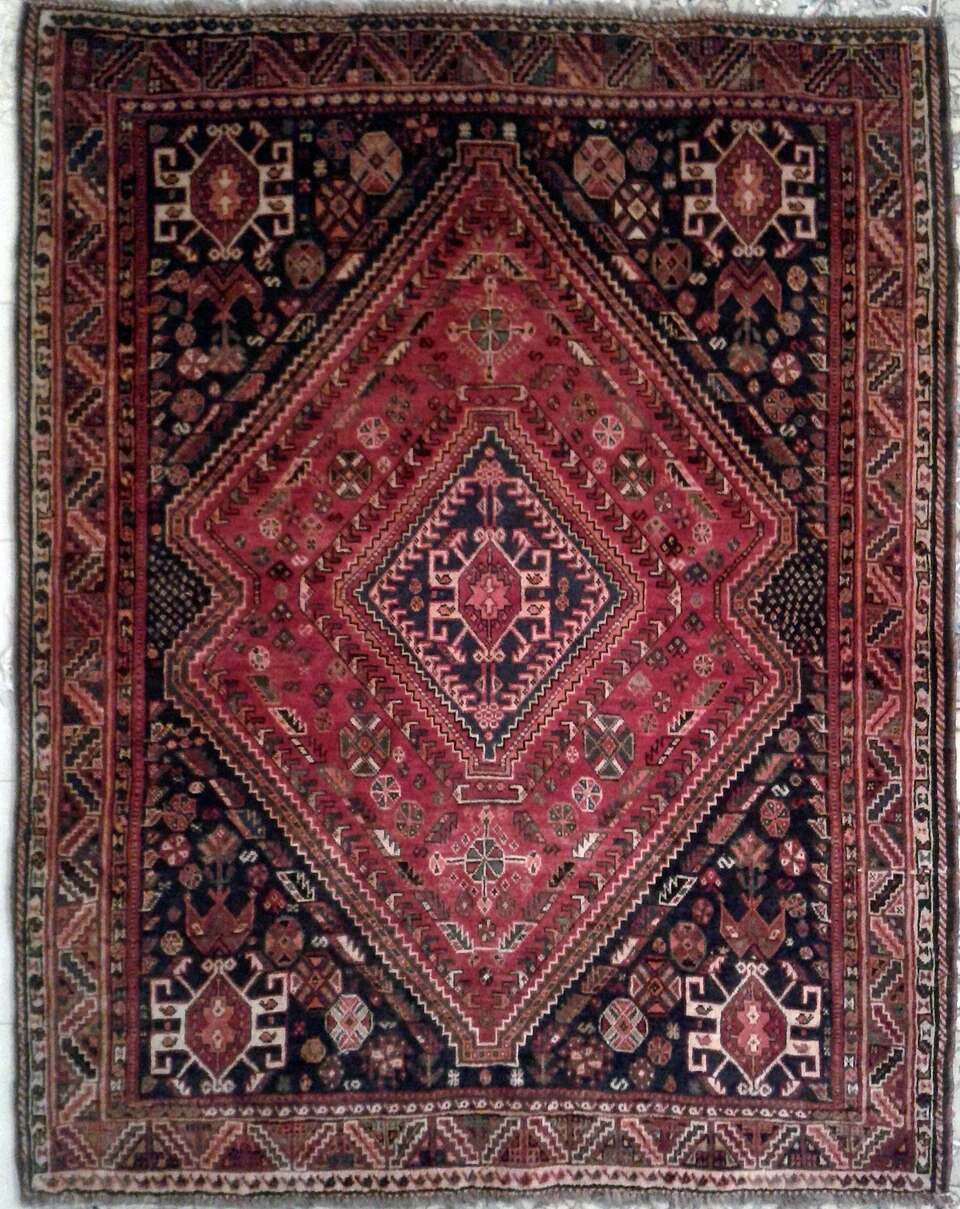
Illustrative photograph of a Persian rug, not a before-and-after cleaning result or evidence of this rug’s fiber composition. Photo: مورخ هنر / Wikimedia Commons, CC BY-SA 3.0. Resized and converted to WebP; same license.
Leave a Reply