
Air duct cleaners: what they actually do and when they help
A homeowner calls air duct cleaners because a return grille is gray with dust, because someone in the house has allergies, because a recent renovation covered the system in drywall powder, or because a neighbor said the furnace “has never been cleaned.” Those are real reasons to look into the service, but they are not all the same problem, and the right response is not the same for each one. Understanding what professional air duct cleaners actually do inside a forced-air HVAC system is the first step in deciding whether the service is worth booking at all.
Professional duct cleaning, as defined by the U.S. Environmental Protection Agency, is the cleaning of the various heating and cooling system components of forced air systems, including the supply and return air ducts and registers, grilles and diffusers, heat exchangers, heating and cooling coils, fan motor and fan housing, and air handling unit housings. The agency is explicit that there is no evidence that routine cleaning improves health, and that duct cleaning has never been shown to actually prevent health problems, which is a useful starting point because it sets a realistic expectation. The service is situational, not preventive in the way that changing a filter is preventive.
What follows is a practical guide to the work air duct cleaners perform, the methods that competent providers use, the conditions that genuinely justify the service, the red flags that suggest a less careful provider, and the questions homeowners can ask to evaluate a quote. It is written for a homeowner who wants to make a real decision, not for someone who has already decided to book the cheapest provider advertising a whole-house deal.
What air duct cleaners actually clean
The phrase “duct cleaning” is a shortcut for a much wider set of components. A thorough service addresses the ducts themselves, but also the parts of the system that supply and collect the air that flows through those ducts. If a provider only vacuums the visible register boots, the work is incomplete.
- Supply ducts and return ducts: the sheet metal or flexible tubes that move air from the air handler to the rooms and back.
- Registers, grilles, and diffusers: the visible covers on walls, floors, and ceilings that can be removed for separate cleaning.
- Heat exchangers and cooling coils: the surfaces inside the furnace and air handler where air is heated or cooled, and where dust and biological growth can accumulate.
- Fan motor and fan housing: the blower assembly that moves air through the system.
- Air handling unit housing: the metal cabinet that contains the blower and coils.
- Plenum and trunk lines: the main supply and return trunks that branch out to individual room runs.
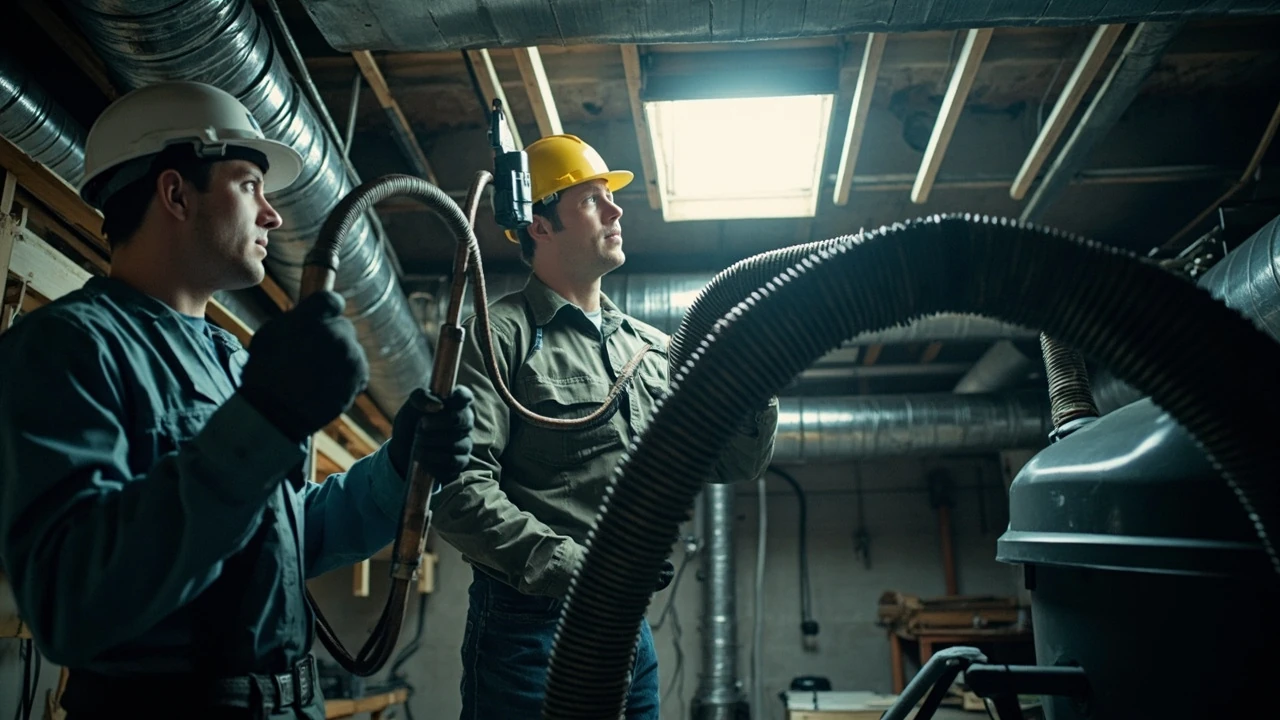
Each of these surfaces can hold dust, pet dander, construction debris, and in some cases biological growth. The work involved is mostly mechanical agitation combined with high-efficiency filtration. A competent provider isolates the section of duct being cleaned, uses a vacuum collection device outside the home or in a contained unit, and dislodges debris with brushes, air whips, or compressed air tools. The captured material is filtered through a HEPA-rated device so that very little is recirculated into the living space.
Methods competent providers use
The National Air Duct Cleaners Association, known as NADCA, publishes an industry standard for the cleaning of HVAC systems. The current standard covers source removal, which is the mechanical dislodging of contaminants and their collection before they can spread. Source removal is the only method NADCA recognizes as acceptable. Sanitizers, sealants, and coatings applied without first removing the contamination are not a substitute for source removal, and they are often a sign that the provider is trying to make a quick job look thorough.
Within source removal, providers use a mix of tools, and the exact combination depends on the duct material and layout. Sheet metal trunks with branch runs to each room are the easiest to clean with negative air machines and rotary brushes. Flexible duct, which is the corrugated plastic tube often run through attics and crawl spaces, is harder to clean mechanically without damaging the inner liner. Many providers use compressed air whips or skip the interior of flex duct entirely and focus on the connections and the air handler side.
Two pieces of equipment tend to separate serious providers from less careful ones. The first is the vacuum collection device, which is either a truck-mounted unit parked outside with a long hose run to the system, or a large portable HEPA-filtered unit inside. The second is the inspection camera, which is used before and after cleaning to confirm what was actually found and what was actually removed. A provider who arrives without either of these tools is probably going to do a less thorough job.
| Method | Best used on | Limitations |
|---|---|---|
| Rotary brush with negative air | Rigid sheet metal supply and return runs | Can damage flexible duct inner liner if used carelessly |
| Compressed air whip | Long flexible duct runs and tight bends | Requires strong vacuum collection to capture dislodged material |
| Hand brushing and vacuum at registers | Visible register boots and accessible trunk sections | Cannot reach deep inside branch runs |
| HEPA-filtered portable vacuum | Whole system or single zone, when truck access is not possible | Capacity is lower than truck-mounted equipment |
| Coil cleaning and fan cleaning | Indoor coil, blower wheel, and housing at the air handler | Requires opening the air handler; often done as part of the same visit |
Conditions that genuinely justify the service
The EPA is clear that routine duct cleaning is not a general health measure. There are, however, specific situations where the work makes practical sense. Homeowners who recognize those situations can avoid paying for a service that will not help and can book the service confidently when it will.
- Visible mold growth inside ducts or on components: if there is biological growth on the inside of the duct, on the cooling coil, or on the fan housing, cleaning and correction of the moisture source are warranted. The provider should also identify and address the moisture that allowed the growth.
- Insect or rodent infestation: if ducts have been used as a route by pests, or contain nests, carcasses, or droppings, cleaning combined with pest control is appropriate. Sanitizers may be useful after the material is physically removed.
- Heavy dust release after renovation or remodeling: drywall dust, sawdust, and other construction debris that has been pulled into the return side of the system can coat coils and ducts. Cleaning restores airflow and reduces the recirculation of fine particles.
- Visible debris at supply registers: if the supply grilles blow out dust, lint, or other material, the ducts likely hold enough of the same material to justify cleaning.
- Move-in cleaning in a previously unknown home: in some cases the previous owner or tenant had pets, smoked indoors, or neglected filter changes, and the new owner prefers to start with a known-clean system.
Each of these situations has a specific trigger that a careful provider will ask about. If a provider quotes a whole-house cleaning without asking what is actually inside the ducts, the work is likely a sales script rather than a response to a real condition.
Conditions that do not justify the service on their own
Many of the reasons homeowners call air duct cleaners are not, on their own, reasons to book the work. The EPA specifically notes that duct cleaning has not been shown to prevent health problems, and that a dirty filter is the more common explanation for dust in a home.
- General dust in the home: most household dust enters from windows, doors, pets, fabric, and human skin. Ducts are usually a smaller source than the room itself.
- Allergies with no identified indoor source: allergies often respond to filter changes, mattress encasements, and reduced humidity, rather than to duct cleaning.
- Routine maintenance at a set interval: most systems do not need duct cleaning on a fixed schedule. The condition of the ducts and the conditions inside the home should drive the decision.
- Concerns about energy bills: a dirty air filter, a dirty coil, or a miscalibrated thermostat are more common causes of high bills than dirty ducts. A practical guide to thermostat work is a useful companion read because thermostat placement and calibration can also drive comfort complaints that get misattributed to the ducts.
How providers should evaluate the system before quoting
A careful provider inspects before quoting. That inspection should include the air handler, the accessible duct trunks, the register boots, the return side, and the filter slot. A provider who quotes over the phone based only on the number of vents is selling a package, not evaluating a system.
For additional context, Inspection tools that competent providers carry include a borescope or inspection camera for looking inside ducts, a manometer or pressure gauge for checking blower performance, and a flashlight or LED scope for the air handler. They should also be willing to remove at least one supply register and one return register to look inside the trunk. Homeowners are entitled to ask to see the inside of the ducts on the camera before work begins and to see the inside again after the work is complete. A provider who refuses is not being unreasonable about trade secrets; they are signaling that the work is unlikely to be thorough.
What a complete service visit should include
The shape of a real duct cleaning visit is fairly predictable. Knowing the order of operations helps a homeowner evaluate whether the work is going to plan or whether the provider is rushing.
- Pre-inspection: visual inspection of the air handler, filter slot, accessible ducts, and a camera look inside at least one supply and one return run.
- System protection: the provider covers the floor near the air handler, seals the supply and return openings not being actively cleaned, and sets up the vacuum collection device.
- Source removal at the air handler: cleaning of the blower wheel, coil, and housing. This is the part most directly tied to airflow and efficiency.
- Branch and trunk cleaning: mechanical agitation of each run, working from the vent end toward the air handler, with the vacuum pulling the dislodged material out of the system.
- Register, grille, and diffuser cleaning: the visible covers are removed, washed, and dried before reinstallation.
- Optional sanitizer application: if used, applied only after the surface is clean, and only with a product appropriate for internal duct surfaces.
- Post-inspection: another camera look to confirm what was removed, and a written summary of the work performed.
Homeowners who want a useful record of the service should ask for before-and-after photos of at least one or two runs, a list of components cleaned, and the brand and model of any sanitizer used. That documentation is also useful if the system is later sold or if a warranty question arises.
Costs, quotes, and how to compare providers
Whole-house duct cleaning is typically quoted as a flat fee for the visit, with add-ons for coil cleaning, sanitizer, dryer vent cleaning, and additional returns or large systems. Pricing varies by region, system size, and access. What matters more than the headline number is what the number includes.
| Line item | What it covers | When to question it |
|---|---|---|
| Whole system cleaning | Supply and return runs, registers, air handler internals | Provider will not show pre- and post-inspection photos |
| Coil cleaning | Cleaning the indoor evaporator coil or heat exchanger surface | Coil is not actually accessed; cleaning is a vacuum at the filter slot only |
| Sanitizer or disinfectant | EPA-registered product applied after cleaning | Applied before cleaning, or used in place of cleaning |
| Cleaning the duct from the dryer to the exterior termination | Not relevant to the HVAC system; sometimes included as a low-cost add-on to the duct job | |
| Filter upgrade or replacement | Higher-MERV filter installed at the air handler | Not the same as duct cleaning; a separate purchase decision |
| Sealant application | Internal duct coating to seal leaks or microbial growth | Used to cover contamination rather than remove it |
Homeowners comparing two or three quotes should normalize the scope. A low quote that excludes the air handler, the coil, or the return side is not the same service as a higher quote that includes those items. It is also reasonable to ask which add-ons are optional and which the provider considers necessary for the specific conditions they found during inspection.
Red flags when hiring air duct cleaners
Duct cleaning is one of the services that attracts aggressive sales tactics, partly because the result is mostly invisible to the homeowner and partly because there is no easy way for a homeowner to evaluate the work after the fact. A short list of warning signs helps separate providers who are doing the work from providers who are running a script.
- “Special” pricing tied to a same-day decision: a coupon that expires as soon as the estimator leaves the driveway is a sales pattern, not a service pattern.
- Guaranteed health benefits: no provider can guarantee that cleaning ducts will relieve a specific medical condition, and any claim to the contrary is unsupported.
- Bait-and-switch on quote structure: a low base price that grows sharply once the technician is inside and “discovers” additional work is common. A written, line-item quote reduces the risk.
- Refusal to open the air handler: a provider who cleans only the ducts and not the air handler is leaving the most contaminated components untouched.
- No before-and-after documentation: a provider who cannot show what was inside the ducts at the start and what was inside at the end is asking the homeowner to take the result on faith.
None of these signs is unique to duct cleaning. They are the same red flags that show up across home services where the work is hard to see. The presence of one is not automatic disqualification, but a pattern of two or three suggests the homeowner should keep looking.
What homeowners can do between cleanings
Most homes do not need frequent duct cleaning. The actions that keep the system in good shape are mostly the same actions that any HVAC technician would recommend. They are also less expensive than professional cleaning and reduce the chance that the next service call is for the same problem.
- Change filters on schedule: a clogged filter reduces airflow, increases dust loading on the coil, and pulls more particles into the return ducts. The right interval depends on filter type, pets, and renovation activity, but most homes benefit from a filter change every one to three months.
- Seal the duct side of the system during renovation: if drywall, sanding, or sawing is happening in the home, return registers should be temporarily sealed so that the system does not pull construction dust into the ductwork.
- Address moisture and humidity: biological growth in ducts and on coils is almost always tied to moisture. A dehumidifier in a damp basement, a repaired drip pan, and a working condensate drain all reduce the chance of growth inside the system.
- Keep the outdoor unit clear: debris around the outdoor condenser reduces system performance and can lead to coil freeze and moisture problems inside.
- Schedule routine HVAC service: a yearly inspection by a qualified technician catches coil and blower issues before they become the kind of contamination that prompts a duct cleaning call.
For households with significant indoor air quality concerns, the more impactful upgrades are usually at the filter and the air handler rather than in the ducts. A higher-MERV filter, properly sized for the system, captures more particles. A standalone room air cleaner with a verified clean air delivery rate for the size of the room can supplement the central system. The clean air delivery rate, sometimes shortened to CADR, is a figure of merit that combines airflow with particle removal efficiency so that filters and room cleaners can be compared on the same scale, and the rating is published by the Association of Home Appliance Manufacturers under the ANSI/AHAM AC-1 standard. Readers who want a more technical reference on how that rating is built and what it does and does not measure can review the underlying clean air delivery rate methodology on Wikipedia, which describes the test conditions, the 2/3 rule for sizing a room cleaner, and the limits of the rating outside residential rooms.
For homeowners already planning a service visit, it can make sense to bundle the duct cleaning with a separate but related task, such as having the dryer vent cleared at the same time. Lint buildup in a dryer vent is a fire hazard, and many of the same providers offer both services. Readers who want a closer look at the dryer side can read a practical overview of what a dryer vent cleaning service actually involves, which describes the signs of a restricted vent and the difference between a superficial cleaning and a full vent line clearing from the appliance to the exterior termination.
Health, evidence, and what duct cleaning can and cannot do
The honest framing of duct cleaning is that the service is a physical cleaning of a part of the home, with the same kind of evidence behind it as a carpet cleaning or a chimney sweep. It removes material that is present. It does not produce general health benefits beyond that. Major public health agencies have been consistent on this point for years.
Specific situations do show a benefit. The EPA notes that if there is visible mold growth inside ducts, the growth and its moisture source should be addressed. The agency also notes that if ducts are infested with pests, the pests and the contamination they leave behind should be removed. In both cases, the work is justified by what is actually in the system, not by a general concern about indoor air.
For households with a member who has a documented respiratory condition, the more evidence-supported steps are usually filter upgrades, source control, and ventilation improvements, all of which have more published evidence than duct cleaning. For households with no specific concern, the practical question is whether the ducts are visibly soiled, whether the system has had recent contamination, or whether the homeowner simply wants a known-clean baseline after a major life event such as a renovation or a move.
Frequently asked questions
How often should air duct cleaners service a typical home?
There is no fixed interval. Most homes do not need duct cleaning on a regular schedule. The decision is driven by visible contamination, renovation activity, pest or moisture problems, or a specific move-in or move-out event. A yearly HVAC service is a better use of the same calendar slot.
Are air duct cleaners worth it for allergies?
Sometimes, and only when there is a specific indoor source. Allergy relief is more reliably tied to filter upgrades, mattress encasements, humidity control, and removal of identified sources. A duct cleaning will not substitute for those steps and is not a general allergy treatment.
How long does a professional duct cleaning visit take?
A typical single-system home takes two to four hours for a thorough job that includes the air handler, the supply and return runs, and the registers. Larger homes, homes with multiple systems, or homes with significant contamination can take longer.
Do air duct cleaners need to enter the home?
Yes. The work is inside the home, at the air handler and at the supply and return registers. A provider who offers a fully external service is either running the vacuum from outside only, or is quoting a partial job.
Is sanitizer necessary after the cleaning?
Not in most homes. Sanitizer is appropriate after cleaning when there was documented microbial growth or pest activity. Routine cleanings on a system with no growth generally do not need a sanitizer, and a sanitizer should never be applied before the surface is clean.
Can duct cleaning damage flexible ductwork?
It can, if rotary brushes are used carelessly on the corrugated inner liner. Competent providers use compressed air whips on flex duct or focus on the connection points and the air handler side. Homeowners with flex duct should ask the provider which method they plan to use.
How do I verify that the work was actually done?
Ask for before-and-after camera photos of at least one supply run and one return run, a written list of components cleaned, and a description of any sanitizer used. A provider who cannot produce that documentation is not giving the homeowner the means to evaluate the work.
What is the difference between duct cleaning and an HVAC tune-up?
An HVAC tune-up is a mechanical inspection and service of the heating and cooling equipment, including the blower, the coils, the refrigerant charge, the electrical connections, and the controls. Duct cleaning is the cleaning of the ductwork and the air handler surfaces. The two services are related but distinct, and a good time to combine them is when the system is being evaluated for a comfort or efficiency complaint.
Do air duct cleaners also handle dryer vents?
Many providers offer both, because the equipment and the technique are similar. The two systems are not connected, but bundling them on the same visit is common and can reduce the per-visit cost. The dryer vent side has its own safety implications because a restricted vent is a fire hazard.
What should I do to prepare the home before a duct cleaning visit?
Clear access to the air handler, the supply and return registers, and the filter slot. Move furniture away from registers. If pets are in the home, plan to keep them in a separate room during the work, because the negative air machine and the agitation tools are loud. The provider should also confirm that the system is off before opening the air handler.
Leave a Reply