
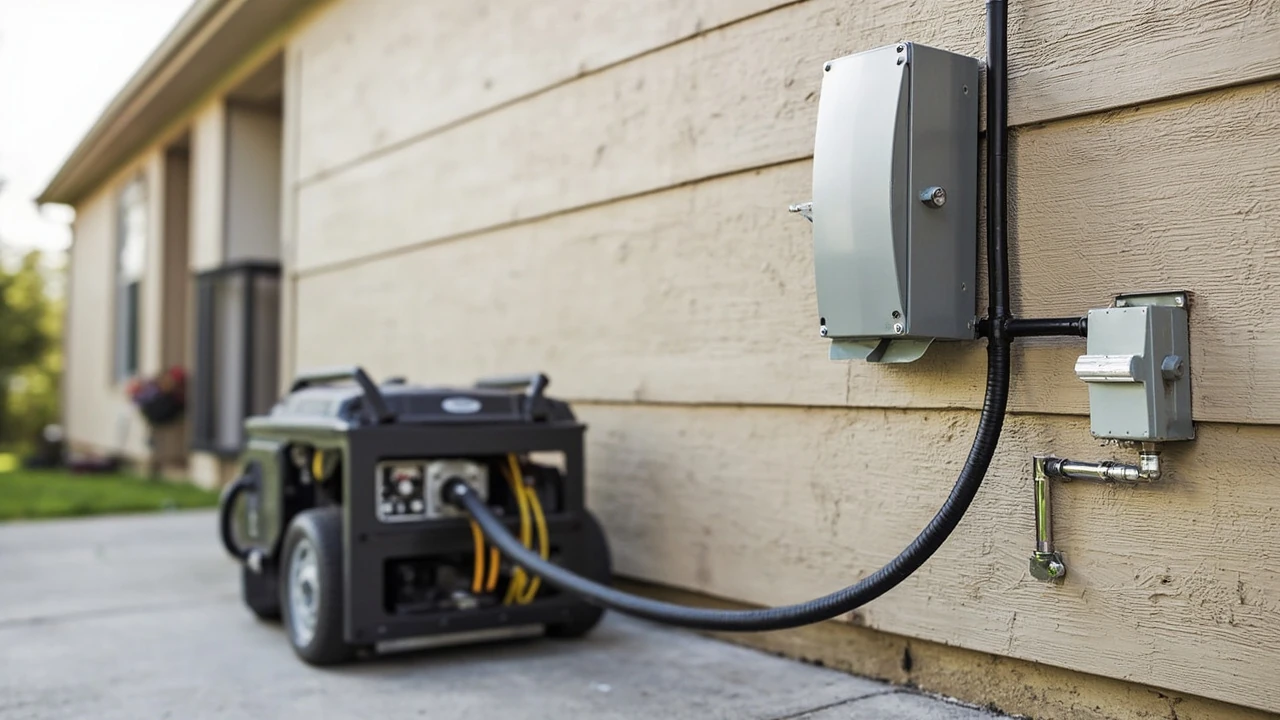
How to connect generator to house: a practical safety-first guide
A storm knocks the neighborhood dark, the refrigerator starts to warm, and the sump pump falls silent. In that moment, the question stops being theoretical. Homeowners across the country regularly need to know how to connect generator to house wiring without creating a fire risk, electrocuting a utility worker, or burning out the equipment they are trying to protect. The good news is that the process is well understood and well regulated. The challenge is that there is more than one acceptable way to do it, and the wrong choice can void insurance coverage or violate local electrical codes.
This guide walks through the realistic options: a code-compliant transfer switch, a budget-friendly interlock kit, an outdoor inlet box with a manual switch, and the much more limited extension-cord path. It also covers the safety rules that apply no matter which method you choose, the tools and permits most jurisdictions expect, and the common mistakes that turn a backup-power setup into a hazard.
Why the connection method matters more than the generator
The generator itself is only half of the problem. The way it ties into your home determines whether it protects your family or endangers them. Two risks dominate every serious discussion of residential generator hookups.
The first is backfeeding. Backfeeding happens when generator electricity flows backward through your home’s wiring and out onto the utility lines. A linesman working several blocks away to restore power has no way to know your house is energizing the grid. Backfeeding has killed utility workers and caused house fires. The only reliable way to prevent it is a device that physically prevents the main breaker and the generator feed from being on at the same time.
The second risk is overload. Generators have a finite output, and a typical home has many circuits that will trip the generator immediately if they all come online at once. A proper connection method lets you select which circuits receive power and which stay dark until the grid returns. This is not just a convenience. It is the difference between a generator that runs for ten hours on a tank of fuel and one that stalls every few minutes under the weight of an electric range, a clothes dryer, and a central air handler.
According to one explainer on connecting a generator to a home safely, even when a transfer switch is the gold standard, there are legitimate alternatives for infrequent outages, including interlock kits and outlet boxes, as long as the homeowner respects local codes and physical limitations.
Three code-acceptable ways to connect a generator to a house
There is no single “right” method. The right answer depends on your generator size, your panel configuration, your budget, and how often the power actually goes out. The table below summarizes the realistic options before we go deeper into each one.
| Method | Best for | Cost range (parts, no labor) | Skill level | Permit typically required |
|---|---|---|---|---|
| Transfer switch (manual or automatic) | Frequent outages, medium to large portable or standby generators | Moderate to high | Licensed electrician strongly recommended | Yes |
| Interlock kit on the main breaker | Occasional outages, portable generators, budget-conscious homeowners | Low | Comfortable homeowner or electrician | Yes in most jurisdictions |
| Outdoor power inlet box with a manual disconnect | Portable generators, homeowners who want a clean plug-in connection | Low to moderate | Electrician recommended | Yes |
| Direct extension cords to appliances | Very small loads, true emergency only, temporary use | Lowest | DIY possible with caution | No, but limited by code to specific cord setups |
Whichever method you choose, the underlying principles stay the same: prevent backfeeding, manage load, and keep the connection point dry, accessible, and labeled so anyone in the household can operate it.
Option 1: Install a transfer switch (the most common compliant answer)
A transfer switch is a dedicated electrical device installed next to or combined with your main service panel. It has two inputs: one from the utility, and one from a generator feed. It has a mechanical interlock so that only one source can feed the house at a time. When utility power is on, the generator side is locked off. When you start the generator and throw the switch, the utility side is locked off, and selected circuits are powered by the generator.
Manual transfer switches are common for portable generators. They are typically sized by the number of circuits they can carry, often six, eight, ten, or twelve. Automatic transfer switches are more common on standby generators. They sense a utility outage, start the generator, and switch the load without anyone flipping a switch.
What a transfer switch actually does for you
- It physically prevents both power sources from feeding your home at the same time, eliminating the backfeeding hazard.
- It allows you to pre-select which circuits the generator will power, such as the fridge, furnace blower, sump pump, and a few lighting circuits.
- It gives you a single, clearly labeled place to control the system, which matters during a stressful outage.
- It provides a code-recognized connection point that insurance carriers and electrical inspectors are familiar with.
How the installation typically goes
- A licensed electrician evaluates your service panel, available amperage, and the circuits you want backed up.
- The switch is mounted next to the panel, either flush or surface mounted, and wired into a dedicated breaker space.
- The circuits you want backed up are moved from the main panel to the transfer switch side. This work must keep the panel and switch bonded and grounded correctly.
- An outdoor generator inlet box is mounted on an exterior wall, and a heavy-gauge cable is run from the inlet to the transfer switch in conduit.
- The system is labeled, the electrician pulls a permit, and the local inspector signs off.
This is the most expensive path, but it is also the path that electricians, inspectors, and insurance underwriters are most comfortable with.
Option 2: Use a breaker interlock kit (a code-accepted shortcut)
An interlock kit is a piece of metal hardware that mounts onto your existing breaker panel. It mechanically blocks the main breaker and the back-fed generator breaker from being in the “on” position at the same time. You can flip one, or you can flip the other, but not both. It is, in effect, a transfer switch built into the panel cover.
Interlock kits are panel-specific. They are not universal. The kit must be listed for your exact panel manufacturer, model, and breaker series. Using the wrong kit is a code violation and a safety hazard, because the metal plate has to align precisely with the breaker positions to do its job.
Where interlocks make sense
Interlocks are a popular answer for homeowners who want a transfer-switch-style safety guarantee without the cost of a separate sub-panel. They are particularly common in regions where the electrical authority explicitly recognizes them as an alternative to a transfer switch for portable generators. The kit is paired with an outdoor inlet box and a back-fed breaker in the main panel, so you plug the generator into the house through a proper weatherproof receptacle, not a suicide cord spliced into the panel.
Step-by-step: how a typical interlock installation works
- Confirm the kit is listed for your panel. The listing label and a matching UL or CSA reference should be in the box.
- Have the utility cut power at the meter, or schedule a brief disconnection, so the panel is dead while you work.
- Mount the interlock plate according to the template, install the back-fed breaker in the correct position, and verify the sliding or pivoting action actually blocks the main breaker when the generator breaker is on.
- Install the outdoor inlet box on a wall in a location where the generator can sit safely outside, away from windows and doors.
- Run appropriately sized wire (commonly 6 AWG for a 30-amp circuit or 4 AWG for a 50-amp circuit) from the inlet to the back-fed breaker in conduit, and bond the inlet box to the grounding system.
- Label every breaker involved, including the warning labels the kit provides, and pull the permit for inspection.
Many jurisdictions that do not require a full transfer switch will accept a listed interlock kit on a permanent, permit-inspected installation. A few still will not. Always check with your local building or electrical department before buying hardware.
Option 3: Outdoor inlet box with a small dedicated sub-panel
If you want a plug-in connection but do not want a full transfer switch, an outdoor power inlet box wired to a small manual sub-panel is a middle path. The inlet is the box on the wall where the generator cord plugs in. The sub-panel is a separate, smaller breaker box that lives next to the main panel and holds only the circuits you want backed up.
This approach does not provide a mechanical interlock by itself. The safety comes from the sub-panel being fed by a single breaker in the main panel, and from the operating procedure: you turn off that breaker before you start the generator, and you turn it back on only after the generator is off. If you forget the procedure, you have a backfeeding problem. That is why many homeowners who choose this method also add a mechanical interlock or a clearly written checklist next to the panel.
The advantage is flexibility. You can size the sub-panel to back up exactly the loads you care about, and you can add circuits later as your needs change. The disadvantage is the discipline required to operate it correctly every time.
Option 4: Extension cords (limited, often misunderstood)
Plugging appliances directly into the generator with extension cords is technically a valid approach for very small loads. A refrigerator, a few lamps, a phone charger, and a sump pump can all be run this way. The reason most electricians discourage it is that it is easy to do badly.
The cords need to be outdoor-rated, of the correct gauge for the distance and load, and used in dry conditions. A light-duty household extension cord run across a wet lawn to power a refrigerator is a fire waiting to happen. The plug ends need to be intact, and the connections should stay out of standing water.
If you go this route, the realistic loads are limited. Central air, electric heat, well pumps, and electric ranges are not practical on extension cords from a portable generator. They draw more current than most cords can safely carry, and they require the kind of switched circuit that an extension cord simply cannot provide.
| Appliance | Typical running watts | Safe on heavy outdoor cord? | Practical on extension cords only? |
|---|---|---|---|
| Refrigerator | 100 to 800 | Yes | Yes |
| LED lamp cluster (5 to 10) | 50 to 100 | Yes | Yes |
| Sump pump (1/3 to 1/2 hp) | 800 to 1,500 | Yes with care | Marginal |
| Portable space heater | 1,500 | Yes with proper gauge | Possible, watch amperage |
| Central air (3-ton) | 3,500+ | No | No |
| Electric range | 2,000 to 5,000 | No | No |
| Well pump | 1,000 to 2,000 | No | No |
For any load beyond a few small appliances, hardwired connection through an inlet, sub-panel, or transfer switch is the only realistic answer.
The safety rules that apply to every method
Whichever path you choose, a short list of rules should be treated as non-negotiable. These are not opinions. They reflect how generators, homes, and utility systems actually behave under fault conditions.
- Never run a portable generator in an enclosed space, including a garage with the door open. Carbon monoxide accumulates faster than most people realize, and it is odorless. Place the generator outside, on a stable surface, at least several feet from windows, doors, and vents.
- Never backfeed the house by plugging the generator into a dryer outlet or any other receptacle without a listed interlock or transfer device. This is the classic mistake that kills linemen.
- Match the generator size to the loads you actually plan to run. A 5,000-watt portable can keep a fridge, a furnace blower, and a few lights alive. A 10,000-watt portable can do more, but it is still not a whole-house solution unless the panel is wired for it.
- Use the correct cord. For a 30-amp inlet, use a 10-gauge (or heavier) outdoor-rated generator cord. For a 50-amp inlet, use 6-gauge or heavier. Cheap cords overheat at sustained high load.
- Bond and ground the system as the manufacturer specifies. Some portable generators have a floating neutral, others a bonded neutral, and the wrong configuration can interact badly with your house grounding.
- Keep fuel stored safely, away from the running generator, and refuel only after the unit has cooled.
- Test the system before the storm hits. Many homeowners install a transfer device, then discover during the first outage that a breaker is mislabeled or a cord is missing.
Permits, codes, and inspection: the part most guides skip
Most jurisdictions treat a permanently installed generator connection device as new electrical work. That means a permit, an inspection, and often a licensed electrician on the job. Skipping the permit is risky for two reasons. First, unpermitted work can complicate a future home sale, because buyer’s inspectors and lenders frequently flag it. Second, in some regions, unpermitted electrical work can void a portion of your homeowner’s insurance that covers fire and electrical damage.
The relevant code in the United States is the National Electrical Code (NEC), and several articles touch residential generator connections. Article 702 covers optional standby systems. Article 700 covers legally required standby systems. Local jurisdictions can and do adopt the NEC with amendments, which is why the same setup might be perfectly fine in one county and a violation in the next.
There is also the question of whether your utility company has its own rules. Some require that you notify them when a permanent generator connection is installed. Some provide a discount or a different rate structure if your transfer device is listed and inspected. None of this is heavy lift. It is paperwork, and it is worth doing.
A realistic pre-storm checklist
Walk through this list before the next forecasted outage, not during one. The goal is to find problems while the lights are still on.
- Confirm the generator starts, runs for at least 20 minutes under a small load, and holds steady voltage. A generator that sits unused for a year often will not start on the first pull.
- Inspect the cord from end to end. Look for cracked insulation, corroded prongs, and missing weatherproof boots.
- Open the transfer device or inlet and look for signs of moisture, insect nests, or corrosion.
- Verify every backed-up circuit is labeled. The person using the system at 2 a.m. may not be the person who installed it.
- Stage a small kit: a flashlight, a printed operating procedure, fuel stabilizer, a fuel funnel, and a battery for electric-start models.
- Run a short simulated outage by throwing the main breaker off and verifying the transfer device and selected circuits work as expected.
Choosing the right method for your situation
If you are trying to decide which path to take, the honest answer is that most homeowners end up choosing based on three questions.
- How often does the power actually go out, and for how long? If outages are rare and short, a simple interlock kit with a small portable generator is a reasonable, code-accepted answer. If outages are long or frequent, a transfer switch or a standby generator with an automatic transfer device pays for itself in convenience.
- What do you actually need to keep running? A fridge, a furnace, a sump pump, and internet gear can be covered with a 5,000- to 7,500-watt portable on a transfer switch or interlock. A central air system or a large well pump changes the calculation substantially.
- What does your local jurisdiction require? Some areas will not accept an interlock. Some will not accept anything but a transfer switch for a permanently installed generator. A quick call to the building department answers this in five minutes and saves a return trip to the hardware store.
Common mistakes that turn a generator into a hazard
The same handful of errors show up in news reports about generator fires and injuries every year. Avoiding them is the single biggest improvement most homeowners can make.
- The suicide cord. A male-to-male cord that lets you plug the generator into a household outlet is illegal, deadly, and still sold in some places. Do not use one under any circumstances.
- Running a generator in a garage, even with the door open. Carbon monoxide is heavier than air in the concentrations that matter, and it pools at human height.
- Overloading the generator on the first day. A 7,500-watt unit can run a 3-ton air conditioner, but it cannot start one alongside a 5,000-watt electric range. Sequencing loads matters.
- Skipping the permit. Unpermitted work is uncovered work, and electrical fires are a common reason claims get disputed.
- Forgetting about maintenance. Fuel stabilizer, oil changes, spark plug service, and a periodic test under load are not optional. A generator that failed last spring will not magically start during a winter storm.
What to expect during a typical transfer-switch install
For a sense of what a real project looks like, here is what most licensed electricians do during a manual transfer switch install on an existing 200-amp service.
- Site visit: the electrician looks at the panel, the available wall space, the distance to a suitable outdoor inlet location, and the existing grounding system.
- Proposal: you receive a written quote that separates the switch, the inlet box, the wire and conduit, and the labor. Permitting fees are usually listed separately.
- Installation day: power is cut, the switch is mounted, circuits are moved, the inlet is wired, and the system is labeled. The power is usually restored the same day.
- Inspection: the city or county inspector verifies the bonding, the conductor sizes, the breaker ratings, and the labeling. The work is not “done” until it passes.
The whole process commonly takes a single working day plus a short inspection visit, and the result is a system that any adult in the household can operate safely in the dark.
Frequently asked questions
Do I legally need a transfer switch to connect a generator to my house?
It depends on your jurisdiction. Many local codes adopt the NEC approach, which treats any permanently installed generator connection as new electrical work that requires a listed transfer device or a code-recognized equivalent. Some jurisdictions accept a listed interlock kit as an alternative. A few allow a simple inlet box with strict operating rules. The only way to know for sure is to call your local building or electrical inspector before you buy anything.
What size generator do I need to back up essential circuits?
For most households, a 5,000- to 7,500-watt portable generator covers the essentials: a refrigerator, a furnace blower, a sump pump, internet and phone gear, and a few lights. To power central air or a large electric range, you typically need a 10,000-watt or larger unit, and you should plan for the locked-rotor starting current of the largest motor, which can be several times its running wattage.
Can I use an interlock kit on any electrical panel?
No. Interlock kits are panel-specific and breaker-series-specific. You must use a kit that is listed for your exact panel manufacturer, model, and breaker family. A wrong-fit plate can allow both the main breaker and the back-fed breaker to be on at the same time, which defeats the entire purpose and reintroduces the backfeeding hazard.
Is it safe to run a portable generator in the rain?
Generators need to be protected from direct rain and standing water, but they also need ventilation. The standard solution is a generator tent or a small open-sided canopy that keeps precipitation off the unit without trapping exhaust. Never enclose a running generator in a way that blocks airflow, and never run it under a tarp that holds heat against the housing.
How far from the house should a generator sit?
Manufacturer guidance varies, but a common minimum is several feet from windows, doors, and vents to keep exhaust from drifting indoors. Carbon monoxide detectors inside the house, ideally battery-backed or hardwired with battery backup, are a non-negotiable companion to any portable generator setup, no matter how well placed the unit is.
What is a “suicide cord” and why is it dangerous?
A suicide cord is a male-to-male extension cord. One end plugs into the generator, the other into a household receptacle, energizing the home’s wiring from the male end. It is illegal under the NEC, it bypasses every safety device designed to prevent backfeeding, and it has killed utility workers. There is no situation in which this is acceptable.
Can I backfeed my panel through a dryer outlet if I turn off the main breaker?
Even with the main breaker off, a dryer outlet backfeed is dangerous. A wrong switch, a tripped breaker, or a helper who does not realize the system is energized can reintroduce the hazard. The proper path is a listed transfer device, interlock kit, or inlet wired through a code-compliant sub-panel. If you do not have the budget for those today, run extension cords to individual appliances and skip the panel entirely.
How often should I test my generator and transfer setup?
A monthly short run under a small load is a good baseline. Quarterly, run a simulated outage by throwing the main breaker off and confirming the transfer device and selected circuits behave as expected. Annually, before storm season, change the oil if due, replace the fuel, check the spark plug, and inspect the cord and inlet for damage.
Will my homeowner’s insurance cover damage from a generator I installed myself?
It depends on the policy and the jurisdiction. Many insurers are comfortable with a permitted, inspected installation done by a licensed electrician. Several are uncomfortable with unpermitted work, and some exclude damage resulting from code violations. The safe move is to pull the permit, pass the inspection, and keep the documentation on file. If a claim ever arises, the paperwork is what makes the conversation short.
Do I need a battery for an electric-start portable generator?
Yes. Electric-start models rely on a small internal battery that slowly discharges even when the generator is not running. A dead battery on the night of a storm means a pull-start under stress, in the dark, in the rain. Replace the battery on the manufacturer’s schedule, and keep it on a maintainer if the generator sits for long stretches.
A final note on the practical part
Learning how to connect generator to house wiring is really three different skills stacked on top of each other. You need to pick a connection method that matches your generator, your panel, and your local code. You need to install it to a standard that will satisfy an inspector and an insurance adjuster. And you need to operate it calmly and correctly during a stressful, dark moment. Get the first two right, and the third one becomes a small habit rather than an emergency.
Before you buy hardware, confirm the kit or switch is listed for your exact panel. Before you run the first cord, confirm the permit is pulled and the inspection is on the calendar. And before the next storm, walk through the simulated-outage drill once with everyone in the house. That is the difference between a generator that protects your home and a generator that just sits on the driveway.
Leave a Reply